Launch Watch · Launch Watch · Evidence study
Published
Artemis I’s 148 launch dates were not 148 launch attempts
NASA’s historical Artemis I calendar contains 148 eligible dates. A 365-day audit shows why those dates cannot be counted as launch attempts.
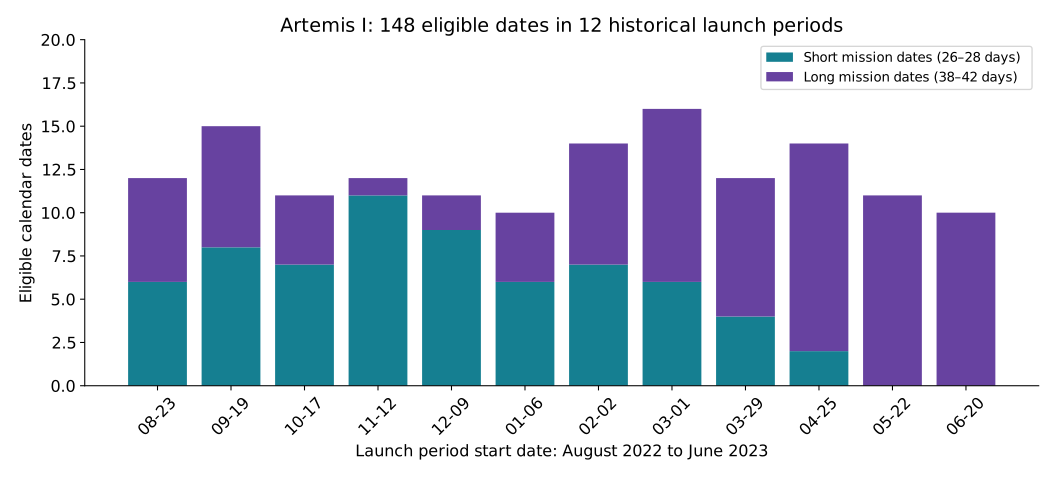
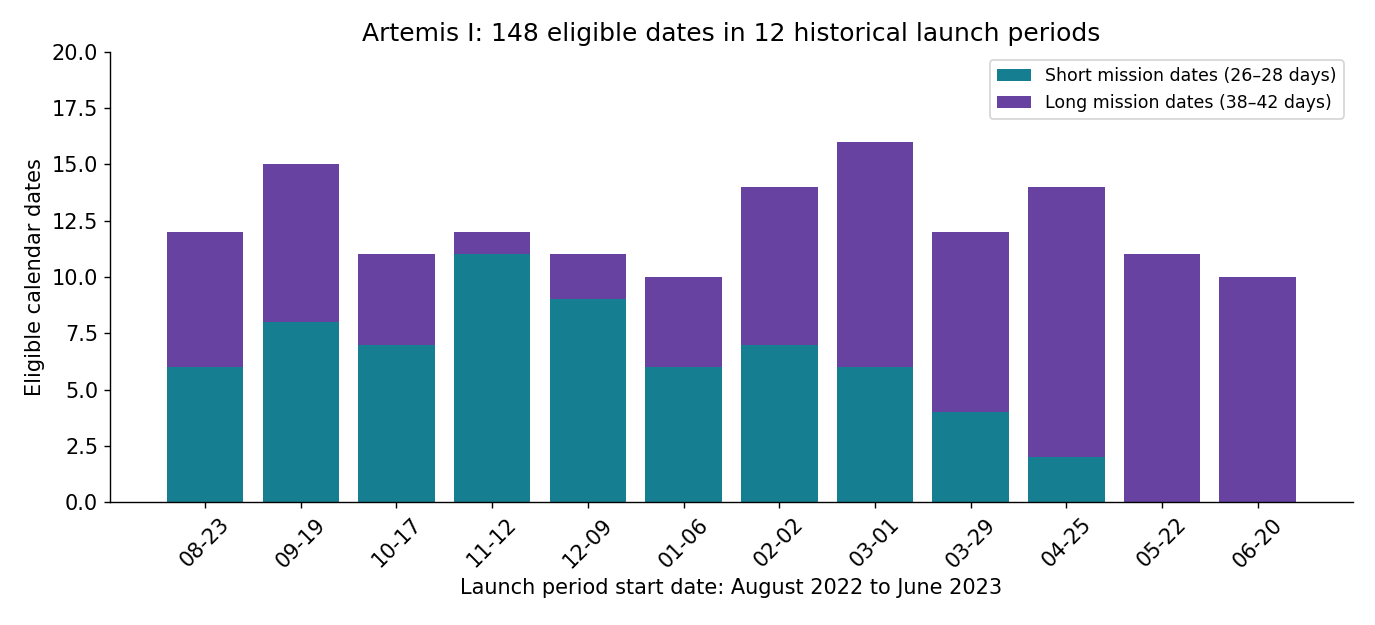
NASA’s historical Artemis I planning calendar contains 148 eligible launch dates, spread across 12 launch periods. It is tempting to read that as 148 chances to try. The operational rules add an important constraint: a second tanked attempt needed at least 48 hours after the first, and a third needed 72 hours after the second.
We transcribed every date in the August 2022–July 2023 display and checked the totals against the calendar’s printed launch-period counts. The resulting dataset shows exactly what those 148 dates represent. It also makes the boundary between calendar eligibility and an executable attempt easier to see.
Open full-size figure · Download PNG figure
Four calendar categories, with different meanings
The June 2022 planning PDF separates long missions, short missions, Orion-constrained dates and dates with no mission available. Across its 365 dates, we count 82 long-mission dates and 66 short-mission dates. Another 30 dates have SLS performance available but violate an Orion constraint. The remaining 187 are classified as having no mission available.
“Long” and “short” describe planned mission-duration ranges: 38–42 days and 26–28 days, respectively. They do not say how many hours a launch window stayed open. Adding the two eligible categories gives 148, while adding all four gives the full 365-day display.
| Period (local dates) | Short mission dates | Long mission dates | All eligible dates |
|---|---|---|---|
| 2022-08-23 to 2022-09-06 | 6 | 6 | 12 |
| 2022-09-19 to 2022-10-04 | 8 | 7 | 15 |
| 2022-10-17 to 2022-10-31 | 7 | 4 | 11 |
| 2022-11-12 to 2022-11-27 | 11 | 1 | 12 |
| 2022-12-09 to 2022-12-23 | 9 | 2 | 11 |
| 2023-01-06 to 2023-01-20 | 6 | 4 | 10 |
| 2023-02-02 to 2023-02-17 | 7 | 7 | 14 |
| 2023-03-01 to 2023-03-17 | 6 | 10 | 16 |
| 2023-03-29 to 2023-04-13 | 4 | 8 | 12 |
| 2023-04-25 to 2023-05-10 | 2 | 12 | 14 |
| 2023-05-22 to 2023-06-06 | 0 | 11 | 11 |
| 2023-06-20 to 2023-07-02 | 0 | 10 | 10 |
Walk through the first period
The period from 23 August through 6 September 2022 spans 15 calendar days. Twelve are eligible: six for long missions and six for short missions. Three dates inside that interval are excluded. Even within one launch period, the date range and the count of available dates therefore answer different questions.
Now look at the six consecutive eligible dates from 23–28 August. A reader could see a daily sequence on the calendar, but NASA’s mission-availability explanation imposed separate tanking limits: at least 48 hours between attempts one and two, at least 72 hours between attempts two and three, and no more than three attempts in seven days.
That is enough to rule out treating every eligible date in the run as a consecutive daily tanked attempt. It is not enough to construct a fully executable schedule. Exact window times, readiness and the other operational conditions would also need to be checked. This analysis does not turn date spacing into a maximum-attempt forecast.
How we checked the calendar
Each printed day number has a position in the PDF. We matched the center of that text box to the original colored rectangle behind it, then mapped the fill to the four legend categories. That keeps the transcription tied to the document rather than inferring categories from a compressed screenshot.
The checks require 365 unique dates and agreement with every one of the 12 printed period subtotals. The downloadable files preserve both the daily classification and the period summary, so readers can reproduce the sums or inspect a particular date.
Keep the version in the claim
This is a historical planning snapshot, identified by the June 2022 PDF filename. It is not a record of actual attempts or a statement of current Artemis rules. Its date labels use Eastern Standard or Daylight Time as printed, rather than UTC.
The supported conclusion is narrow and useful: this calendar offered 148 eligible dates under its mission-planning criteria, while tanked attempts were subject to additional spacing rules. Neither launch probability nor weather and hardware readiness can be recovered from the category counts. For the underlying concept, see why launch windows are short; use the NASA launch schedule for a separate current-planning question.
Sources and data
Source snapshots were retrieved on 6 October 2026. The observation dates and product versions are stated above; retrieval does not make a historical record current.
Download B439_periods.csv (CSV) · Download B439_calendar_dates.csv (CSV)