What confidence labels need to mean before readers can trust them
A launch-evidence card says “high confidence.” What is high: confidence that a feature is present in an image, that it belongs to a particular launch, or that the launch achieved its mission? Until the label names its claim and explains its basis, the reader has to supply the meaning.
A useful confidence label should travel with a short explanation: the exact proposition, the evidence considered, the unresolved alternatives, and the conditions that would change the assessment. The worksheet below helps an editor ask for that explanation. It is a proposed editorial tool, not a description of a LaunchDetect scoring system or a completed validation study.
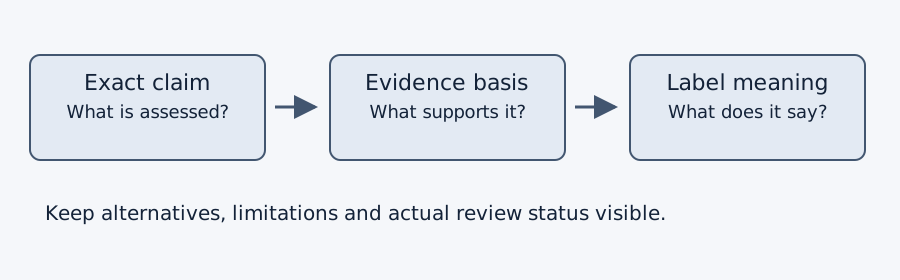
Separate the question from the strength of its support
“An unusual feature appears in this scene” and “this scene shows the named launch” are different propositions. “The payload reached its intended orbit” is another. A label attached to one should not quietly apply to the others.
There is also a useful distinction between assessing an event’s likelihood and assessing the basis for that assessment. The UK government’s guidance on explaining uncertainty treats probability and analytical confidence as separate aspects: the former addresses whether a statement is true, while the latter concerns the strength and stability of its supporting assessment. That is an example from a specific professional framework. Its categories and probability ranges are not a launch-detection standard.
For an evidence article, start by writing the proposition in ordinary language. Include the event, place, interval, and evidence type only as precisely as the source permits. If the proposition changes while you edit the headline, reassess the label rather than carrying it over automatically.
Complete a label contract
This original worksheet is a practical agreement between the person assigning a label and the person using it. Complete it for each consequential claim. A blank means the information is still needed; it does not silently mean the check passed.
| Field | What to record | Question for the reader |
|---|---|---|
| Claim | The single sentence being assessed | Which proposition does this label cover? |
| Evidence basis | Identified sources, versions, and the part of each that bears on the claim | Can I inspect the basis? |
| Meaning of the label | The documented definition and who applies it | Is this a judgment, a measured quantity, or an estimated probability? |
| Alternatives | Other explanations considered and their unresolved status | What could change this interpretation? |
| Limitations | Missing information, scope restrictions, and dependencies | Where should I stop relying on it? |
| Reviewer | Actual review status and responsible role, when known | Has the stated review happened? |
| Version | Assessment version, assessment time, and revision trigger | Would newer evidence require a new label? |
Put the claim and a short limitation next to the label. A separate methods page can hold the longer explanation, but the label should not become misleading when a card is copied or a caption is read alone. Use the words as well as any color or icon so the meaning remains available without color perception.
A synthetic example that refuses a premature number
Imagine a teaching record called “Example A.” It contains a scene with a bright feature and a schedule naming a launch attempt in the same broad period. The scene’s identity and acquisition time have been recorded, but the editor has not established whether the feature belongs to that attempt.
A proposed label contract might read:
- Claim: “The identified scene contains the bright feature described in the caption.”
- Evidence basis: the identified scene and its documented display settings in this fictional exercise
- Separate unresolved claim: attribution of that feature to the named launch attempt
- Alternatives to examine: another source of the feature, a time mismatch, or a processing issue
- Reviewer: not yet assigned
- Version: teaching example 1; revisit if the source scene or interpretation changes
This record is ready to describe its evidence gap. It is not ready to declare “high confidence in mission success.” A better temporary caption is: “The scene contains a bright feature; its association with the named attempt remains unverified in this example.” No percentage is needed to express that boundary.
Do not manufacture percentages from adjectives
Assigning the numbers 90, 60, and 30 to the words high, medium, and low would create a new scale. It would not, by itself, establish that the resulting percentages describe real-world outcomes. If a source supplies a numerical score, preserve its documented meaning instead of relabeling it as a probability.
Before presenting a label as a validated probability, ask for a separate methods review. The following are review questions, not evidence that calibration has been performed:
- What exactly counts as a positive outcome, and who determines it?
- Which cases were evaluated, and which cases were unavailable or excluded?
- Were the evaluation cases separate from those used to choose the scoring rules?
- How were assigned probabilities compared with observed outcomes, with uncertainty reported?
- Which instruments, environments, and time periods does the evaluation cover?
- What would trigger re-evaluation after data or methods change?
Until those answers are available, use a qualitative explanation with an honest scope. Do not borrow a familiar probability scale from another discipline to fill the gap.
Make the next check visible
A confidence statement is more useful when it identifies what would resolve the remaining doubt. “Need more information” leaves the next editor guessing. “Locate the original scene identifier and establish its relation to this launch attempt” is an actionable request.
For a broader source review, use the launch-claim verification guide. For planning an evaluation, use the pilot scorecard. The label contract has a narrower purpose: it keeps the claim, its support, and its limits together wherever the confidence word appears.