Launch Watch · Current evidence
Published
Crew-12’s undocking target shifted seven hours. Here are both clocks.
Compare NASA’s October 3 and October 5 Crew-12 undocking targets in EDT, UTC and Hawaii time, with handover and splashdown kept distinct.
NASA’s October 5 update places Crew-12’s undocking target at 8:05 a.m. EDT on October 7, seven hours later than the target published October 3. That difference is large enough to change the calendar date for a reader in Hawaii. It also explains how two NASA pages can show different times while describing the same upcoming departure.
This is a comparison of two dated announcements, checked for the October 5 update. The October 3 commercial-crew post gave a no-earlier-than target of 1:05 a.m. EDT on October 7. The October 5 station post gave 8:05 a.m. EDT that day. Both are future schedule statements at the time of this comparison; a target time is subject to operational updates.
One event, two versions of the target
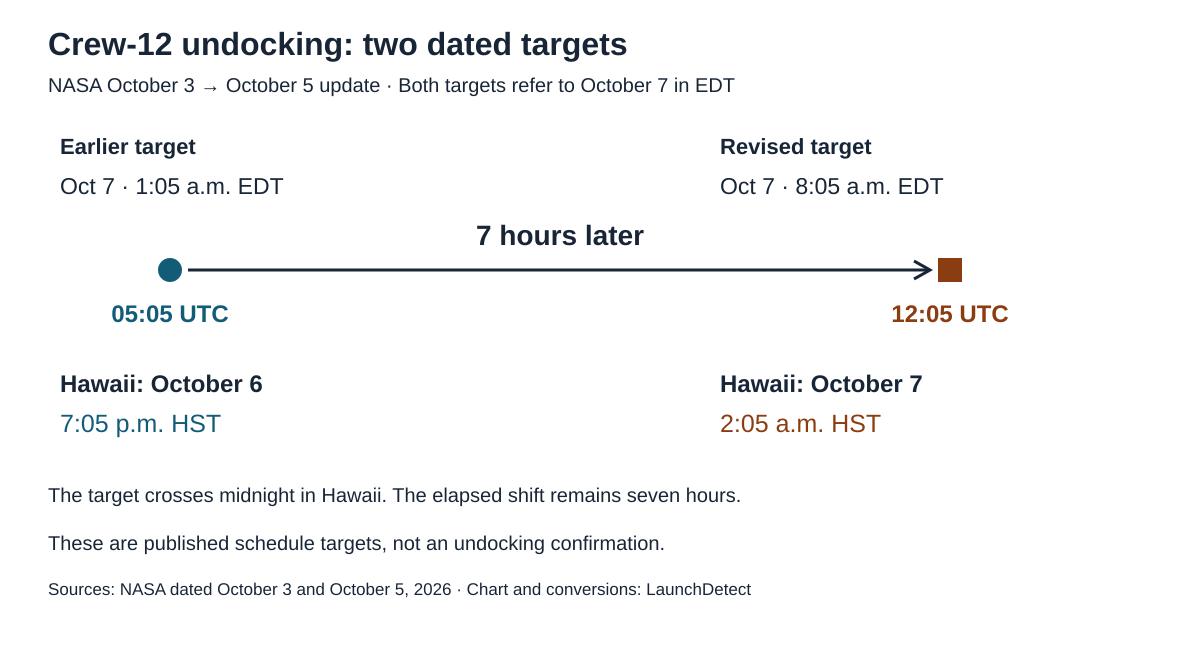
| NASA source date | Published EDT target | Calculated UTC | Calculated Hawaii time |
|---|---|---|---|
| October 3 | October 7, 1:05 a.m. EDT | October 7, 05:05 UTC | October 6, 7:05 p.m. HST |
| October 5 | October 7, 8:05 a.m. EDT | October 7, 12:05 UTC | October 7, 2:05 a.m. HST |
EDT is four hours behind UTC; Hawaii Standard Time is ten hours behind UTC. Converting both versions to the same clock gives 12:05 minus 05:05, a seven-hour shift. Converting either version to another zone preserves that difference. The date change in Hawaii comes from the revised target crossing local midnight.
The California recovery location does not change the label on the undocking time. NASA explicitly labels these two departure targets EDT. Reading either as Pacific time would introduce a new conversion error before any comparison even begins.
The handover happened before departure
The October 5 NASA report confirms that Pyotr Dubrov accepted International Space Station command from Jessica Meir on October 4. That completed ceremony and the forthcoming Crew-12 undocking are separate events. The outgoing crew can transfer station responsibilities while its Dragon remains docked.
| Milestone | Date in the reports | Status in the October 5 account |
|---|---|---|
| Station command transfer | October 4 | Completed |
| Crew-12 undocking | October 7 | Scheduled for 8:05 a.m. EDT |
| Crew-12 splashdown | October 8 | Future target; see time-zone note below |
For a reader following the return, this separation prevents a common misunderstanding: a farewell or change-of-command report does not establish that the spacecraft has departed. An undocking confirmation, when issued, will answer a later operational question; splashdown confirmation will answer another.
The splashdown clock needs its own check
The two posts also give different October 8 splashdown clock times: 11:25 a.m. in the October 3 post and 11:34 a.m. in the October 5 post. The splashdown sentence in each inspected source does not explicitly repeat a time zone. We therefore leave those clock readings in their source form and do not convert them or use them to calculate the return flight’s duration.
That is a narrower uncertainty than the undocking comparison. Both departure times explicitly say EDT, so their seven-hour difference can be calculated. The landing-time label needs explicit confirmation from a current NASA return or coverage update before it belongs in a local-time planner.
What the timing change tells us
The October 3 update explains that departure depends on spacecraft and recovery-team readiness, weather, sea conditions and other factors, with the precise recovery plan selected closer to undocking. These are the conditions NASA says it monitors. The difference between the two published targets does not establish which factor caused the seven-hour revision.
Preserving both versions is still useful. A reader can identify whether an old calendar entry, screenshot or search result came from the earlier announcement. The publication date on the source provides the version history; the date and zone attached to the event provide the intended moment.
How to use this comparison
For a live viewing plan, start with the dated October 5 NASA update and check NASA’s newer station or commercial-crew announcements before the event. Treat 8:05 a.m. EDT on October 7 as the target in that report, rather than a promise that the departure will occur at that minute. Check separately for live coverage, undocking and splashdown announcements.
The downloadable target-history CSV keeps each source date, event name, source URL and three fully dated time stamps together. To reproduce the calculation, parse the two EDT timestamps with their −04:00 offsets, convert to UTC, then subtract. The result is 25,200 seconds, or seven hours. For Hawaii, convert the same instants to −10:00; the earlier version falls on October 6 and the later version on October 7.