Launch Watch · Launch Watch · Evidence study
Published
Crew Dragon’s first five operational flights took 16 to 29 hours to dock
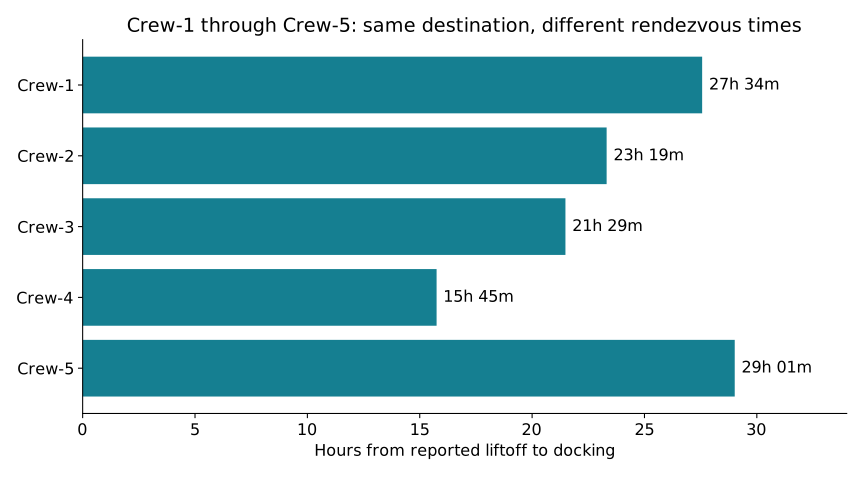
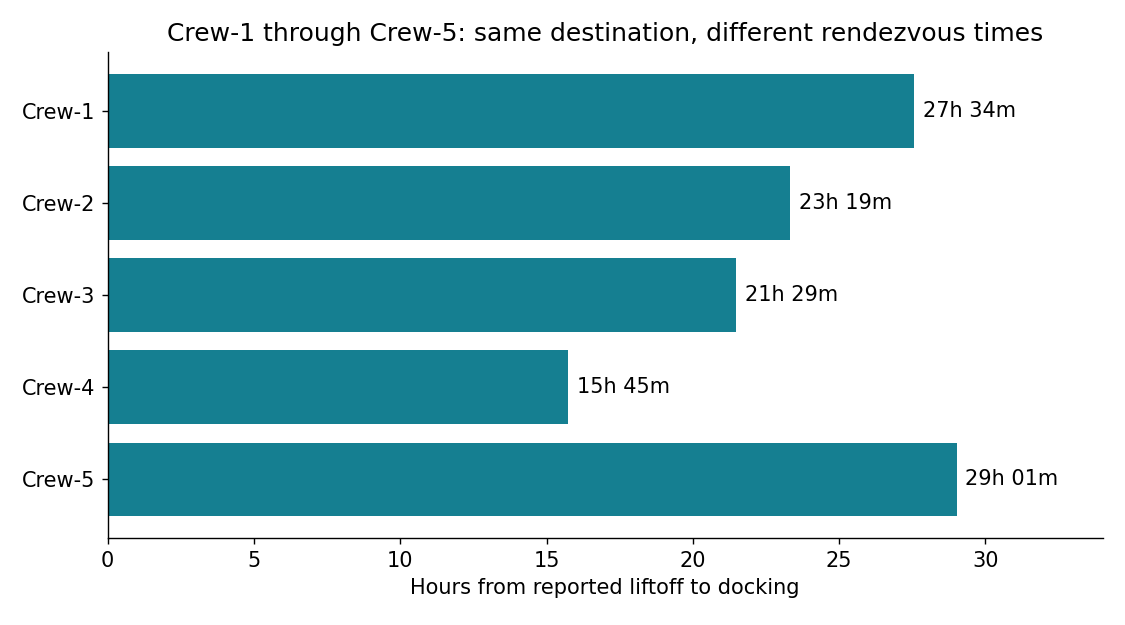
NASA reports put Crew-1 through Crew-5 launch-to-docking intervals between about 15 hours 45 minutes and 29 hours 1 minute, a 13-hour-16-minute spread.
After watching a Crew Dragon launch, how long was the wait for docking? For the first five operational missions, NASA’s event reports give intervals ranging from about 15 hours 45 minutes to 29 hours 1 minute. The longest wait in that set exceeds the shortest by 13 hours 16 minutes.
Those five consecutive missions offer a useful planning lesson: “the next day” can conceal a wide range of elapsed times, and a calendar date depends on the timezone. It is better to track a separately announced docking milestone than to infer one from liftoff alone.
Open full-size figure · Download PNG figure
A consecutive historical sample
We selected Crew-1 through Crew-5, the first five consecutive operational Crew Dragon missions. Demo-2 and later missions are outside the sample. This avoids choosing only unusually fast or slow rendezvous and makes the boundary of the comparison easy to reproduce.
The approximate intervals are 27 hours 34 minutes for Crew-1, 23 hours 19 minutes for Crew-2, 21 hours 29 minutes for Crew-3, 15 hours 45 minutes for Crew-4 and 29 hours 1 minute for Crew-5.
| Mission | Launch UTC | Docking UTC | Elapsed, about |
|---|---|---|---|
| Crew-1 | 2020-11-16 00:27 | 2020-11-17 04:01 | 27h 34m |
| Crew-2 | 2021-04-23 09:49 | 2021-04-24 09:08 | 23h 19m |
| Crew-3 | 2021-11-11 02:03 | 2021-11-11 23:32 | 21h 29m |
| Crew-4 | 2022-04-27 07:52 | 2022-04-27 23:37 | 15h 45m |
| Crew-5 | 2022-10-05 16:00 | 2022-10-06 21:01 | 29h 01m |
Convert both endpoints before subtracting
NASA reported Crew-1’s launch at 7:27 p.m. EST on 15 November 2020 and docking at 11:01 p.m. EST on 16 November. In UTC, those become 00:27 on 16 November and 04:01 on 17 November. Both date labels move forward, while the elapsed time remains 27 hours 34 minutes.
Crew-4 provides a different calendar example. It launched at 3:52 a.m. EDT and docked at 7:37 p.m. EDT on 27 April 2022. That is about 15 hours 45 minutes, with both milestones on the same Eastern date. “Same day” and “next day” are descriptions of calendar labels, not substitutes for calculating a duration.
The CSV preserves the reported Eastern offsets as well as the converted UTC endpoints. EST is UTC−5 and EDT is UTC−4 in these records. Dropping those offsets before subtraction could create an hour error or an incorrect date.
Docking is one milestone in the arrival sequence
This comparison ends at the initial docking reported by NASA. It does not end at hatch opening or the welcome ceremony. A viewing plan that treats all three as interchangeable could point someone to the wrong part of a broadcast.
Likewise, the starting endpoint is the observed launch time in the event report, not an earlier planned launch time. Joining a planned start with an actual docking would answer a different question about schedule performance.
The calculation and its precision
For each mission, we pair NASA’s launch and docking reports, retain the stated EST or EDT offset, convert both timestamps to UTC and subtract. The source files for each endpoint are named in the downloadable data, allowing a reader to follow an interval back to both event records.
The source reports express the times to minutes. The resulting elapsed durations are therefore approximate at that precision, not second-accurate telemetry. The chart and table do not add invented seconds to make the comparison appear more exact.
Subtracting the shortest selected interval, 945 minutes, from the longest, 1,741 minutes, gives a spread of 796 minutes, or 13 hours 16 minutes. This is the spread within these five missions, not an all-time program record.
Use history as context, then check the new mission
Rendezvous timing depends on mission geometry and operations, but these timestamps alone do not explain each difference. The sequence should not be fitted into a simple faster-every-flight story: Crew-5’s interval is longer than Crew-4’s.
The historical range helps a launch viewer understand why docking deserves its own schedule entry. It is not a guarantee for the next flight. For a new mission, use the latest mission-specific times and keep launch, docking, hatch opening and welcome as distinct events.
Sources and data
Source snapshots were retrieved on 6 October 2026. The observation dates and product versions are stated above; retrieval does not make a historical record current.