Launch Watch · Evidence study
Published
DART’s 2024 period numbers: why 18 seconds go missing
Reproduce DART’s reported orbital-period arithmetic and see why a rounded 11h55m baseline cannot recover a second-level change.
Subtract 11 hours, 22 minutes and 3 seconds from 11 hours and 55 minutes. The result is 32 minutes and 57 seconds. Yet JPL’s March 2024 DART account reports that Dimorphos’s orbital period became 33 minutes and 15 seconds shorter. Where did the extra 18 seconds go?
The problem starts with treating a minute-level prose summary as an exact baseline. JPL gives the pre-impact period as 11 hours and 55 minutes, while its later modeled period and total reduction are reported to the second. Converting that rounded summary into 42,900 seconds does not recover precision that was never printed.
This worked check preserves the numbers as published, labels what each one represents, and performs the arithmetic in seconds. It explains the precision trap without claiming a new orbit determination.
One account contains different kinds of number
NASA’s DART spacecraft struck Dimorphos on September 26, 2022. The JPL account published March 19, 2024 describes an observation-constrained modeling study of its orbit around Didymos. It reports an immediate post-impact modeled period and a later settled modeled period, as well as a total reduction relative to before impact.
| Entry | Published or calculated duration | Seconds | Status |
|---|---|---|---|
| Pre-impact prose summary | 11 h 55 m | 42900 | Rounded baseline; not exact |
| Immediate post-impact modeled period | 11 h 22 m 37 s | 40957 | Seconds as reported; uncertainty not assigned here |
| Later settled modeled period | 11 h 22 m 03 s | 40923 | Seconds as reported; uncertainty not assigned here |
| Reported total period reduction | 33 m 15 s | 1995 | Source says calculation accurate to within 1.5 seconds |
The phase labels are important. “Immediate” and “later settled” refer to the physical stages described by the researchers. March 19, 2024 is the publication date of the public account. It is not the observation date for both values, and these entries are not a time series of separate announcements.
The public account says the final calculation is accurate to within 1.5 seconds. That wording is retained as reported. This article does not reinterpret it as a specific statistical confidence interval, assign it independently to every number, or use it to draw uncertainty bands.
Put the reported values on a readable scale
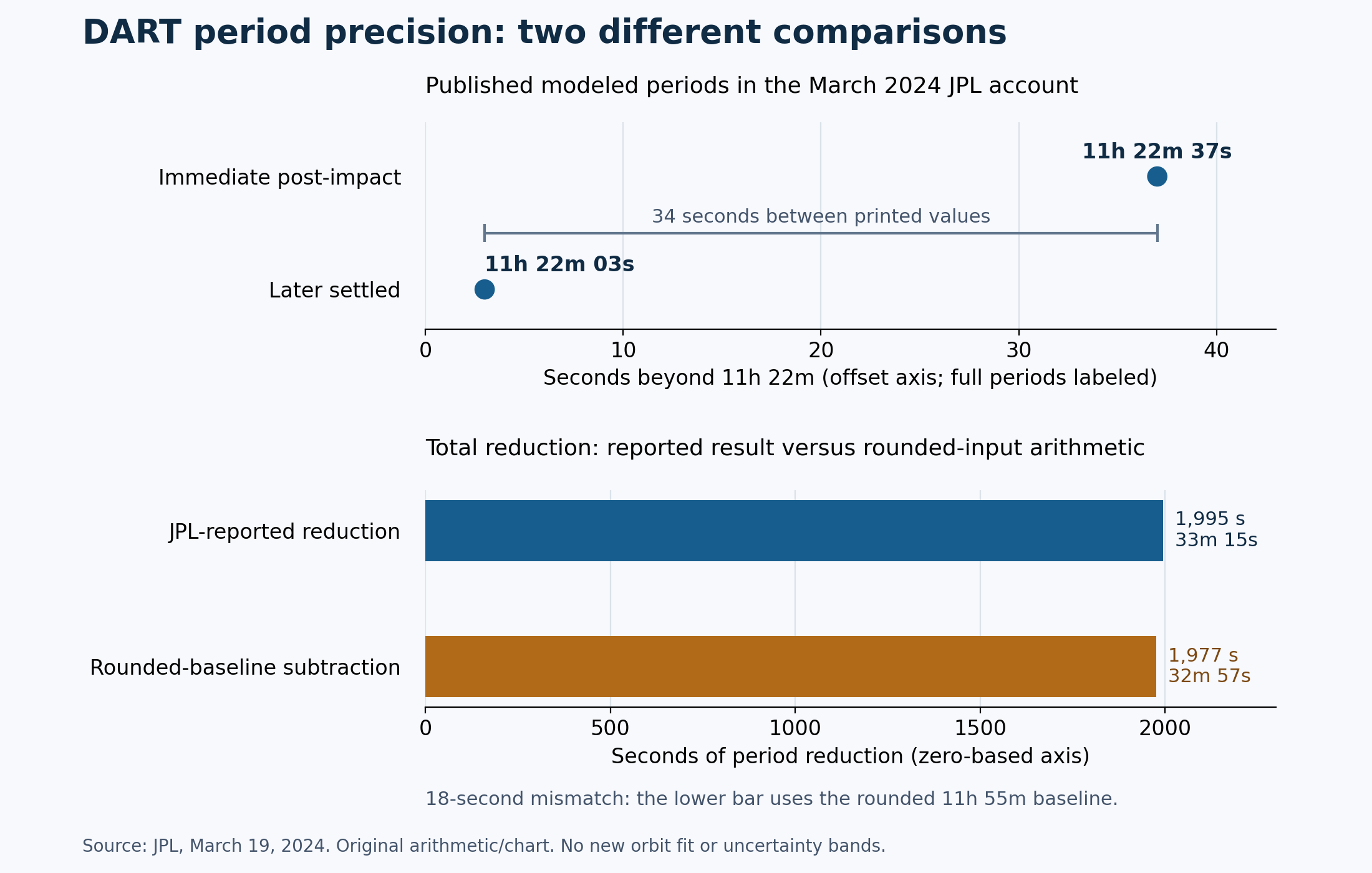
The chart’s upper panel places the two post-impact periods on an offset axis. Both contain 11 hours and 22 minutes; the remaining parts are 37 seconds and 3 seconds. Their printed-value difference is therefore 34 seconds.
Using an offset makes this small difference visible without presenting either period as only a few seconds long. The full durations remain written beside the points and in the table. The phase categories are deliberately not positioned on a calendar axis because this exercise does not establish exact observation epochs for them.
The lower panel has a different role. It compares the reported total reduction with the number obtained from a rounded-baseline subtraction. Those bars must not be mistaken for two measured changes. One is a research result reported by JPL; the other is arithmetic that deliberately uses the less precise prose value.
Reproduce the 18-second mismatch
| Check | Arithmetic in seconds | Result | What it means |
|---|---|---|---|
| Post-impact printed periods | 40,957 − 40,923 | 34 seconds | Difference between two reported modeled values |
| Rounded pre-impact minus later period | 42,900 − 40,923 | 1,977 seconds = 32m57s | A calculation using a coarse baseline |
| Reported reduction minus that calculation | 1,995 − 1,977 | 18 seconds | Mismatch caused by treating the rounded baseline as exact |
The unit conversion is straightforward. Eleven hours contributes 39,600 seconds. Adding 55 minutes gives 42,900 seconds for the rounded pre-impact summary. The later printed period is 39,600 plus 1,320 plus 3, or 40,923 seconds. Subtracting gives 1,977 seconds.
The separately reported reduction, 33 minutes and 15 seconds, is 1,995 seconds. The difference between 1,995 and 1,977 is 18 seconds. This result diagnoses the precision lost by the shortcut; it does not identify an instrument error, a new dynamical event or a contradiction in the underlying orbit fit.
Nor should the calculation be reversed to manufacture a newly established exact pre-impact period. Adding two rounded or reported summary numbers can produce an arithmetic value, but it does not turn that value into an independently checked research estimate. The input precision and the source’s model definitions still matter.
Try the calculation before revealing the answer: 11h55m minus 11h22m03s
The result is 32m57s. It differs from the source-reported 33m15s reduction by 18 seconds because the 11h55m baseline was quoted only to the minute. Keep the baseline’s rounded status attached to the result.
Does the 34-second difference represent a new measurement here?
No. It is 40,957 minus 40,923 seconds, calculated from the two modeled periods printed in the 2024 public account. The astrophysical inference belongs to the cited researchers; this article reproduces the numerical comparison.
Precision, uncertainty and phase are separate fields
A useful data record needs more than a number and unit. In this case it also needs the physical phase, whether the number is a summary or modeled result, and how its precision is described. Dropping any of those fields makes a chart easier to misread.
Precision is about how the value is represented. The uncertainty or accuracy statement concerns how the research result should be interpreted. The phase identifies the stage of the system being described. Extra digits in a calculation cannot replace any of them.
This is why the chart avoids combining a rounded pre-impact point, two second-level post-impact estimates and a quoted accuracy statement into one apparently uniform measurement series. The table preserves their different roles so the arithmetic remains useful rather than deceptively exact.
What the check establishes
The calculation establishes three results from the printed numbers: the post-impact periods differ by 34 seconds; subtracting the later value from the rounded baseline gives 32m57s; and that is 18 seconds below the reported total reduction. All three can be reproduced from the table.
No raw light curve, radar observation or orbit fit was reprocessed. The detailed primary-paper uncertainty convention was not independently validated, so this article stays within JPL’s accessible public numerical account. It is a historical reading of the 2024 results, not a claim about the latest orbital solution.
When a precise result refuses to match a quick subtraction, the first useful check is often the baseline’s precision. Here, carrying the word “rounded” alongside 11h55m prevents 18 seconds of arithmetic from turning into a false scientific mystery.
Source and chart use
- JPL: NASA Study: Asteroid’s Orbit, Shape Changed After DART Impact, March 19, 2024. Source for the modeled periods, phase descriptions, rounded pre-impact summary, reported reduction and accuracy wording.
- The chart is an original rendering of published factual values. It reproduces no third-party illustration and implies no NASA or JPL endorsement.