Independent confirmation and repeated copies of the same claim
Five pages repeat the same launch time. Before calling that five-source confirmation, ask where each page obtained the time. All five may lead back to one announcement.
Repeated reporting can be accurate and useful. It may help readers find an announcement, explain its context, or translate it. The verification question is narrower: how many separately obtained lines of evidence support the particular claim you intend to publish?
This guide offers an original five-node source map and a worksheet for answering that question. It does not evaluate any real outlet or establish a numerical confidence score.
Trace the claim rather than the website
A single article can contain several kinds of evidence. Its launch time might come from an operator’s release, its photograph from a wire service, and its description of a sound from the reporter’s own observation. Treat those as separate claim relationships rather than giving the whole article one independence label.
Reuters’ sourcing standards encourage cross-checking, clear attribution, and explicit acknowledgment of what is unknown. They also caution against describing a single source as several. The map below applies that general sourcing discipline to a fictional launch-reporting exercise; it is not a Reuters-prescribed scoring method.
Start with one sentence: “Example Mission lifted off at 12:00 UTC.” Then trace the origin of that sentence in each source. Do the same exercise separately if you also want to report the launch site, vehicle, payload separation, or orbital outcome.
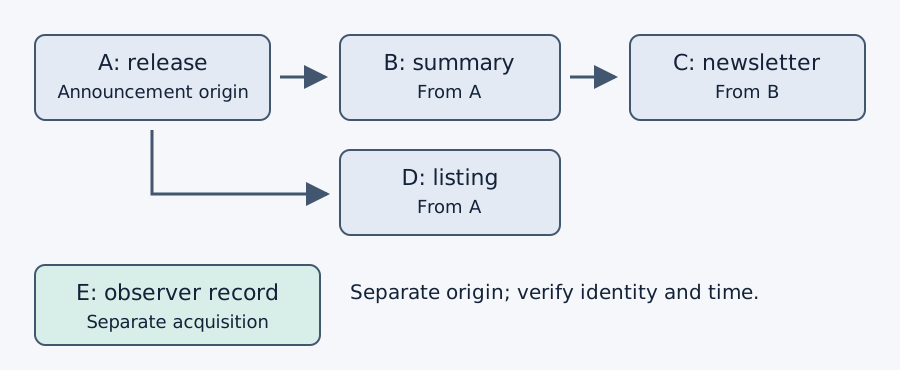
An original five-node source map
Everything in this example is invented for teaching. No node represents a real organization, mission, observation, or publication.
| Node | What it contains | Where this claim came from |
|---|---|---|
| A: operator release | Says Example Mission lifted off at 12:00 UTC | The originating announcement in this exercise |
| B: news summary | Repeats the launch time and attributes it to the operator | A |
| C: newsletter | Repeats B’s account with a link | B, therefore A |
| D: event listing | Displays the same time and links to the release | A |
| E: observer record | Separately acquired observation of an ascending object, with original recording and time documentation | Its own observation, subject to verification |
The dependency paths are A to B to C, and A to D. E has a separate acquisition path. A, B, C, and D therefore provide one originating announcement for the time claim in this exercise. Their four URLs do not create four independently obtained measurements.
E adds a second evidence origin, but its scope still needs work. Does it identify the same event and place? Is its time label understood? Does the observation establish the exact time in the sentence, or only an event within a broader interval? An independent origin can be relevant without supporting every detail of the announcement.
A careful summary would be: “The operator reports the launch time. Three other pages repeat that announcement. A separately acquired observer record may corroborate part of the event account, pending its identity and timing checks.” That description preserves useful reporting without claiming more confirmation than the exercise contains.
Use a dependency worksheet
Create one row per claim-source pair. A source that supports two claims may need two rows with different dependencies.
| Field | What to write |
|---|---|
| Target claim | The sentence and its intended precision |
| Source and location | URL, document version, and relevant paragraph, table, or frame |
| Claimed basis | Direct observation, named announcement, interview, analysis, or unknown |
| Upstream origin | The earliest identified source of this particular information |
| Shared dependency | Common recording, dataset, announcement, witness, or processing method |
| Added contribution | New observation, new analysis of existing material, context, or repetition |
| Unresolved check | The specific identity, timing, or provenance question still open |
The “added contribution” field matters. Two analysts working from the same recording may provide independently reasoned interpretations while sharing the recording’s limitations. Record both facts. Do not collapse independent analysis and independent acquisition into the same category.
What to do when the origin is unclear
Repeated wording, identical cropping, or the same unusual timestamp can be a reason to investigate a shared origin. They are not proof of copying or misconduct. Look for attribution, credits, linked source material, and a stated reporting method. If those do not resolve the dependency, write “origin not established in the material reviewed.”
Also check whether apparent corroboration is circular. In a hypothetical loop, B cites C, and C ultimately cites B. Neither path leads to the claimed original evidence. Mark the loop and leave the underlying claim unresolved until you find an adequate source. Adding the two pages to a bibliography does not repair the missing origin.
An official announcement is still a source to attribute and inspect. Its institutional role can be relevant to the claim, but it does not remove the need to read what it actually says, preserve qualifications, and watch for corrections.
Write the outcome in useful language
Choose wording that reflects the completed map:
- “Several outlets report the operator’s announcement” when the pages share that origin
- “A second, separately acquired observation supports this part of the account” when its provenance and scope have been established
- “Two analyses reach similar interpretations of the same source imagery” when the analysis is separate but the observation is shared
- “The upstream source remains unresolved” when the chain cannot yet be completed
Avoid turning the number of origins into a probability. Two origins can share a clock, a data feed, or an unexamined assumption. The map organizes evidence relationships; it does not quantify reliability.
Use the launch-claim verification guide for the wider review and the source-linked evidence brief to hand off the result. The useful deliverable is a short explanation of who knows what, how they know it, and which dependencies remain.