Launch Watch · Launch Watch · Current evidence
Published
IXPE’s Cas A calibration: 2021 in the catalog, 2026 in the files
Cas A’s three IXPE files list a 2026 calibration where the catalog lists 2021. Our 181-observation audit checks the archive’s processing-version mix.
For IXPE’s first baseline observation of Cassiopeia A, the public catalog and the current data files report different calibration versions. The IXMASTER row lists 20211118. All three detector files list 20260610 in their primary FITS headers. Their observation IDs and processing-software strings agree.
The discrepancy matters now because HEASARC announced an IXPE reprocessing campaign on September 18, 2026, and NASA highlighted it in its September 30 data release roundup. Our October 6 check finds a mixed early-mission archive: 15 of 181 eligible public observations carry the same IXPE pipeline version as the refreshed Cas A files. The practical result is a specific provenance check to make before combining observations.
One observation, two calibration labels
IXPE measures X-ray polarization, helping researchers study objects such as black holes, neutron stars and supernova remnants. Its archive identifies the Cas A observation as 01001301, beginning January 11, 2022. The new announcement concerns processing of older observations, rather than new photons collected in September.
We retrieved the catalog and the complete primary header from each of Cas A’s three public Level-2 event files. FITS is the astronomy file format; its header records the product’s identity and processing information. The IXMASTER documentation defines its calibration field as the CALDB version used in processing. The files’ CALDBVER keyword identifies their calibration-index version.
| Record | Calibration version | IXPE pipeline version | Processing or creation date |
|---|---|---|---|
| IXMASTER catalog row | 20211118 | 1.11 | July 6, 2026 |
| Detector 1 primary header | 20260610 | 1.11 | July 6, 2026 |
| Detector 2 primary header | 20260610 | 1.11 | July 6, 2026 |
| Detector 3 primary header | 20260610 | 1.11 | July 6, 2026 |
The catalog and all three files agree on the full software string, Hea_26Sep2025_V6.36_IXPE_07SEP2025_1.11. We also cross-checked the detector exposure values. Each catalog value agrees with the corresponding file’s LIVETIME to the catalog’s stated 0.0001-second precision; the largest absolute difference is 0.000039 seconds. These checks support the record-to-file match.
The calibration labels themselves remain inconsistent. We have not established why the catalog contains the older label or whether other observations have the same discrepancy. For this observation, cite the file-level value when describing the files analyzed, and preserve the catalog discrepancy in the provenance record. The mismatch alone does not establish an error in the scientific measurements.
The wider archive still has a version mix
We queried all 348 IXMASTER rows and independently checked that total with a second count query. To define a public early-mission sample, we required archived status, a public date earlier than October 6, 2026, and an observation start before April 8, 2025. That last date is the cutoff named in the reprocessing announcement.
The resulting sample contains 181 unique observation IDs. Fifteen, or 8.3%, list IXPE pipeline 1.11; 166 list earlier pipeline labels. Grouping by the IXPE version alone gives eight labels. Version 1.6 appears under two different HEASoft strings, which remain separate in the downloadable row-level data.
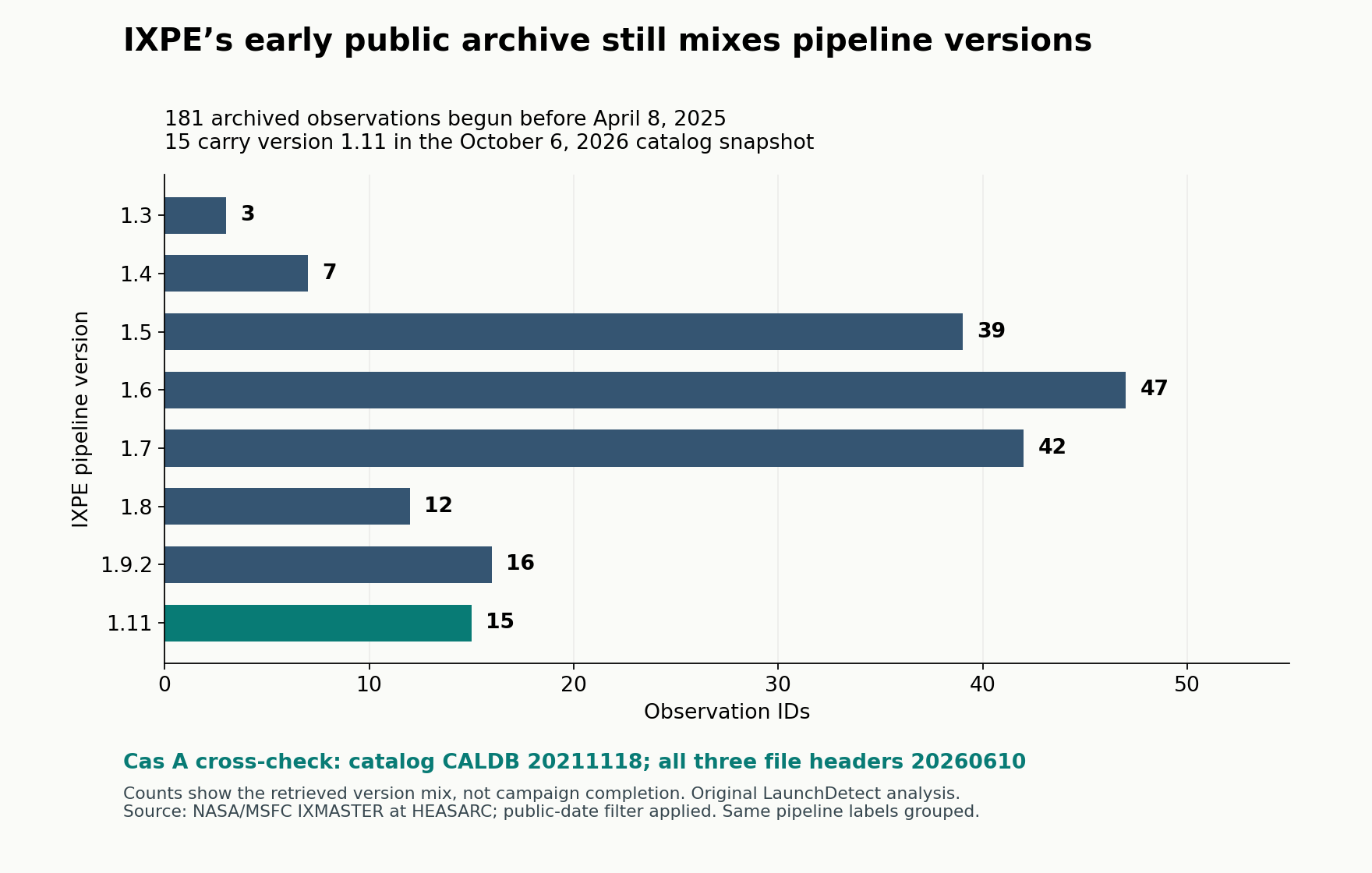
The mix also occurs within repeated target names. The ten early public rows labeled exactly MRK 501 span five IXPE pipeline versions: 1.5, 1.6, 1.7, 1.9.2 and 1.11. Selecting one target name therefore does not select a uniform processing history. This is an exact catalog-name comparison; we did not merge astronomical aliases.
Why 8.3% is not a progress meter
The campaign announcement says reprocessing can improve energy gain, aspect determination and exposure time. Those potential benefits cannot be quantified from a current catalog alone. We did not retain earlier versions of the same event files, run the IXPE processing pipeline, or measure a before-and-after change in polarization or flux.
Processing dates also precede the announcement for some of the 15 observations. Cas A’s three inspected file-creation dates are July 6, 2026; another matching-version row, Tycho 01001401, has an April 1 processing date. Counting these as 15 newly completed jobs since September 18 would invent a campaign history. Our numerator means only that 15 selected rows carry the matching software string in this snapshot.
A second selection issue affects access claims. The catalog contains 252 rows labeled archived, but eight of those have public dates later than October 6. We excluded them, leaving 244 public-date-qualified archived rows before applying the early-observation cutoff. HEASARC explicitly directs users to check public_date. No restricted event file was requested for this audit.
Repeat the check on the files you actually use
- Find the observation ID in IXMASTER and check its public date. Retain the complete software string and the catalog’s processing date.
- Open each detector’s Level-2 file header. Compare OBS_ID, SOFTVER, CALDBVER and DATE, rather than assuming one catalog field answers every provenance question.
- Keep the three detector records distinct. For this audit, the LIVETIME-to-exposure comparison provides an additional numerical cross-check.
- When comparing scientific results across processing versions, use the appropriate mission analysis guidance and matched data products. A version census cannot supply a correction factor.
We used ordinary HTTP byte-range reads of the public compressed files, then decompressed enough data to read each complete primary header. We did not download or analyze the complete photon-event tables. The CSV comparison records the exact header values and file identities; it does not claim full-file checksum validation. Observation dates, file-creation dates, the September announcement and our October retrieval each retain their own meaning.
For a separate worked example of numerical differences between processing products, see our NOAA flare-record comparison. Here, the verified result is narrower: Cas A’s current file headers and catalog disagree on the calibration label, within an early archive that still contains several processing histories.
Sources and downloadable data
Sources were checked October 6, 2026. The observation sample begins in January 2022 and ends before April 8, 2025; the catalog was retrieved in October 2026. Public CSVs preserve the selection flags so the denominator can be inspected.
- HEASARC IXPE archive and September 18 reprocessing announcement
- NASA September 30 data and software highlights
- IXMASTER field definitions
- IXMASTER full-table query, returned as a VOTable
- Cas A’s public Level-2 event-file directory
- HEASARC data-use policy
Download the 348-row catalog audit (CSV) · Download the pipeline counts (CSV) · Download the Cas A header comparison (CSV)
Data credit: IXPE is a joint NASA and Italian Space Agency mission led by Marshall Space Flight Center. This analysis uses data products from the IXPE Science Operations Center at MSFC, developed with algorithms from the IXPE Collaboration and distributed by HEASARC, a service of the Astrophysics Science Division at NASA/GSFC. The chart and calculations are original LaunchDetect work. No agency endorsement is implied.