Launch Watch · Spaceflight
Published
Juno’s orbit changes, reconstructed from 77 perijove dates
Calculate 76 intervals from NASA’s 77 Juno perijove dates, track the moon-encounter steps, and separate historical cadence from the unflown 14-day plan.
Juno’s nominal wait between close Jupiter passes shrank from 53 days to 33 days. That is a 37.7% shorter interval, equivalent to about 60.6% more passes per unit time in a simple reciprocal-period comparison. Both percentages describe the same change, with different denominators.
NASA’s published perijove table makes the intervening steps visible. Taking differences between all 77 dates yields 76 calendar intervals clustered around 53, 43, 38, 35 and 33 days. The historical sequence also explains why the original 14-day science-orbit plan should not be inserted into a chart of the listed encounters.
A date record, from insertion to PJ76
A perijove is a closest approach to Jupiter. The NASA orbit table starts with Jupiter orbit insertion, labeled PJ0, on July 5, 2016. The retained table ends at PJ76 on September 14, 2025. Its dates are explicitly UTC.
We subtracted each date from the next one, without rounding a fitted orbital period or filling gaps between numbered rows. The perijove identifiers run continuously from 0 through 76. Since the first row has no predecessor, 77 rows provide 76 adjacent intervals, not 77.
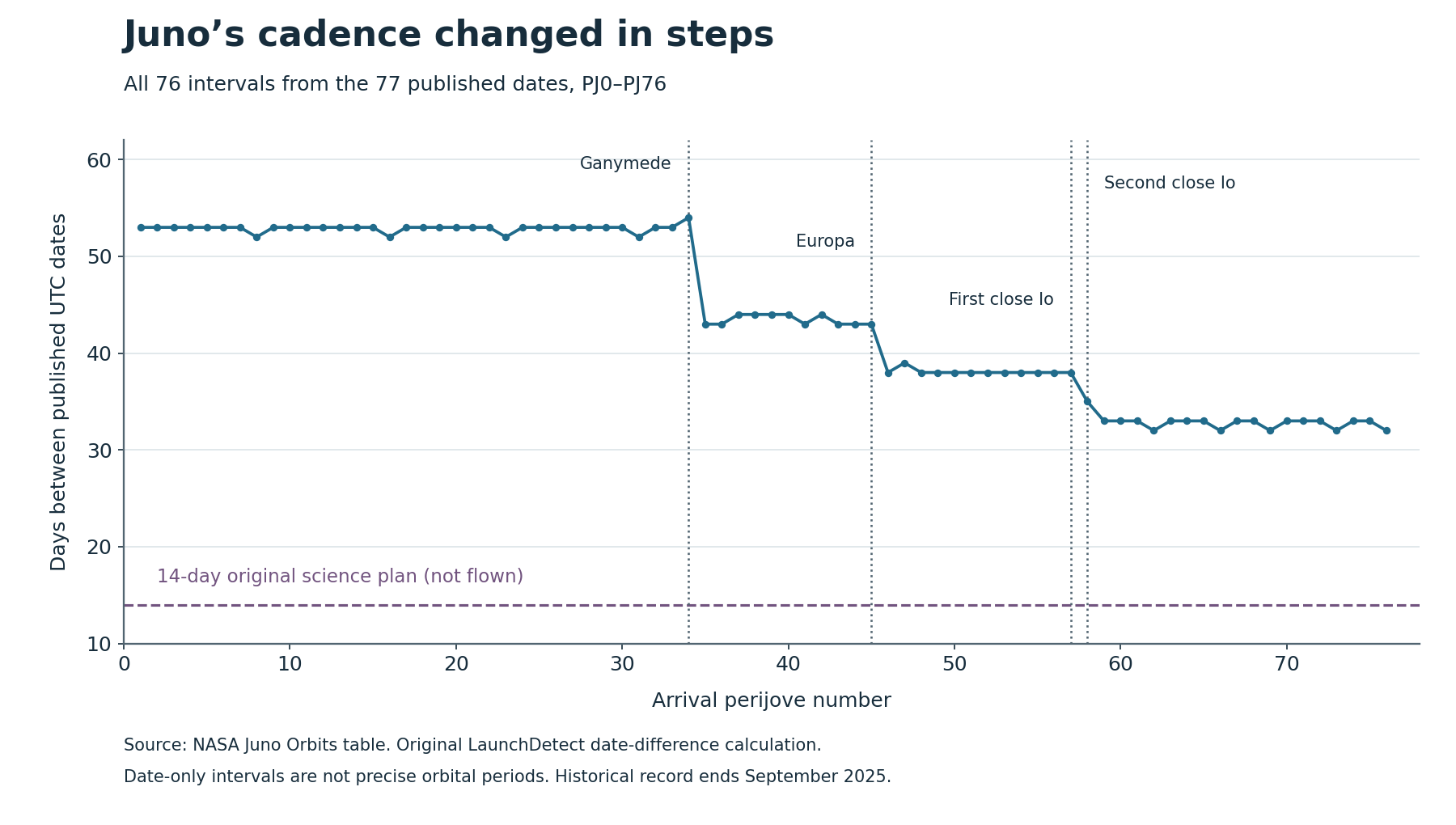
The chart shows every calculated interval. It is a calendar-scale check on the published encounter history, rather than an ephemeris calculation. Its dashed 14-day reference is marked as the unflown original plan and contributes no data points to the interval series.
The five interval groups
| Stage | Arrival perijoves | Intervals | Range (days) | Mean (days) |
|---|---|---|---|---|
| Before the June 2021 Ganymede change | PJ1–PJ34 | 34 | 52–54 | 52.91 |
| After Ganymede, before Europa | PJ35–PJ45 | 11 | 43–44 | 43.45 |
| After Europa, before the first close Io pass | PJ46–PJ57 | 12 | 38–39 | 38.08 |
| Between the two close Io passes | PJ58 | 1 | 35 | 35.00 |
| After the second close Io pass | PJ59–PJ76 | 18 | 32–33 | 32.72 |
“Arrival perijove” identifies the endpoint of an interval. The PJ35 point, for example, is the time between the PJ34 and PJ35 dates. This convention places a changed cadence at the first subsequent interval that exhibits it, rather than assigning the new period backward to the approach before the moon encounter.
The group means are calculations from day-resolution dates. Their two decimal places make the arithmetic auditable; they do not supply hundredth-of-a-day orbital-period measurements. The first group’s 52–54-day spread and the last group’s 32–33-day spread need that context before anyone treats individual differences as anomalies.
Match the steps to encounters without moving their dates
NASA’s mission account attributes the large changes to the Ganymede, Europa and Io encounter sequence. It describes the June 7, 2021 Ganymede flyby reducing the nominal period from 53 to 43 days, followed by the September 2022 Europa encounter reducing it to about 38 days.
The perijove table’s PJ34 date is June 8, 2021, one day after the Ganymede encounter cited in the mission account. A nearby moon flyby and closest approach to Jupiter are different events. The table’s highlight labels should therefore be used as context, rather than silently becoming exact timestamps for the moon encounters.
The Io transition is especially easy to check directly. PJ57 is dated December 30, 2023; PJ58, February 3, 2024; and PJ59, March 7, 2024. The adjacent date differences are 35 and 33 days. A December 2023 JPL announcement described the planned changes from about 38 to 35 and then 33 days, while the later mission account describes the resulting 33-day orbit.
Why 14 days remains a separate line
In its February 17, 2017 decision announcement, NASA said Juno would remain in its 53-day orbit rather than perform the planned burn to reach a 14-day science orbit. Concerns about the propulsion system drove that decision.
Keeping the 14-day plan visible can explain why older mission descriptions differ from later ones. Including it as though it were a flown segment would change the historical claim. The date sequence analyzed here contains no 14-day adjacent interval.
A shorter wait and a faster cadence use different arithmetic
For nominal 53- and 33-day periods, the interval reduction is (53 − 33) ÷ 53 × 100 = 37.7%. Encounter frequency is proportional to one divided by the period. The relative frequency increase is therefore (53 ÷ 33 − 1) × 100 = 60.6%.
The reciprocal calculation compares idealized repeating periods. It does not count a particular year’s scheduled passes and does not measure science return. Instrument choices, geometry, operations and the observations actually obtained would all matter before translating encounter cadence into a science-yield claim.
Method and limits
The complete date-and-interval CSV preserves the source’s identifiers, UTC dates and highlights. For each row after PJ0, we parse both adjacent dates and subtract them in calendar days. Stage boundaries use the arrival-perijove ranges displayed above, and the summaries include every resulting interval exactly once.
Whole dates omit the time of day. Two events separated by a period near 33 days can land 32 or 33 calendar dates apart depending on their times, so a 32-day entry alone is not evidence of unexpected dynamics. Precise periods require precise event times or trajectory data.
This analysis ends at the retained table’s September 2025 endpoint. It makes no claim about Juno’s present health, a next encounter, or whether every listed pass achieved all intended science. The output is a reproducible view of the published historical cadence and the definitions needed to interpret it.
Read all 77 dates and their adjacent intervals
| Perijove | Published date (UTC) | Days since previous date |
|---|---|---|
| PJ0 | 2016-07-05 | No previous row |
| PJ1 | 2016-08-27 | 53 |
| PJ2 | 2016-10-19 | 53 |
| PJ3 | 2016-12-11 | 53 |
| PJ4 | 2017-02-02 | 53 |
| PJ5 | 2017-03-27 | 53 |
| PJ6 | 2017-05-19 | 53 |
| PJ7 | 2017-07-11 | 53 |
| PJ8 | 2017-09-01 | 52 |
| PJ9 | 2017-10-24 | 53 |
| PJ10 | 2017-12-16 | 53 |
| PJ11 | 2018-02-07 | 53 |
| PJ12 | 2018-04-01 | 53 |
| PJ13 | 2018-05-24 | 53 |
| PJ14 | 2018-07-16 | 53 |
| PJ15 | 2018-09-07 | 53 |
| PJ16 | 2018-10-29 | 52 |
| PJ17 | 2018-12-21 | 53 |
| PJ18 | 2019-02-12 | 53 |
| PJ19 | 2019-04-06 | 53 |
| PJ20 | 2019-05-29 | 53 |
| PJ21 | 2019-07-21 | 53 |
| PJ22 | 2019-09-12 | 53 |
| PJ23 | 2019-11-03 | 52 |
| PJ24 | 2019-12-26 | 53 |
| PJ25 | 2020-02-17 | 53 |
| PJ26 | 2020-04-10 | 53 |
| PJ27 | 2020-06-02 | 53 |
| PJ28 | 2020-07-25 | 53 |
| PJ29 | 2020-09-16 | 53 |
| PJ30 | 2020-11-08 | 53 |
| PJ31 | 2020-12-30 | 52 |
| PJ32 | 2021-02-21 | 53 |
| PJ33 | 2021-04-15 | 53 |
| PJ34 | 2021-06-08 | 54 |
| PJ35 | 2021-07-21 | 43 |
| PJ36 | 2021-09-02 | 43 |
| PJ37 | 2021-10-16 | 44 |
| PJ38 | 2021-11-29 | 44 |
| PJ39 | 2022-01-12 | 44 |
| PJ40 | 2022-02-25 | 44 |
| PJ41 | 2022-04-09 | 43 |
| PJ42 | 2022-05-23 | 44 |
| PJ43 | 2022-07-05 | 43 |
| PJ44 | 2022-08-17 | 43 |
| PJ45 | 2022-09-29 | 43 |
| PJ46 | 2022-11-06 | 38 |
| PJ47 | 2022-12-15 | 39 |
| PJ48 | 2023-01-22 | 38 |
| PJ49 | 2023-03-01 | 38 |
| PJ50 | 2023-04-08 | 38 |
| PJ51 | 2023-05-16 | 38 |
| PJ52 | 2023-06-23 | 38 |
| PJ53 | 2023-07-31 | 38 |
| PJ54 | 2023-09-07 | 38 |
| PJ55 | 2023-10-15 | 38 |
| PJ56 | 2023-11-22 | 38 |
| PJ57 | 2023-12-30 | 38 |
| PJ58 | 2024-02-03 | 35 |
| PJ59 | 2024-03-07 | 33 |
| PJ60 | 2024-04-09 | 33 |
| PJ61 | 2024-05-12 | 33 |
| PJ62 | 2024-06-13 | 32 |
| PJ63 | 2024-07-16 | 33 |
| PJ64 | 2024-08-18 | 33 |
| PJ65 | 2024-09-20 | 33 |
| PJ66 | 2024-10-22 | 32 |
| PJ67 | 2024-11-24 | 33 |
| PJ68 | 2024-12-27 | 33 |
| PJ69 | 2025-01-28 | 32 |
| PJ70 | 2025-03-02 | 33 |
| PJ71 | 2025-04-04 | 33 |
| PJ72 | 2025-05-07 | 33 |
| PJ73 | 2025-06-08 | 32 |
| PJ74 | 2025-07-11 | 33 |
| PJ75 | 2025-08-13 | 33 |
| PJ76 | 2025-09-14 | 32 |
Sources
- NASA: Juno Orbits table. All 77 rows, PJ0-PJ76, 2016-07-05 through 2025-09-14; dates explicitly UTC.
- NASA: Juno to remain in its current orbit (February 17, 2017). February 17, 2017; retain 53-day orbit, avoid planned 14-day period-reduction burn following valve concerns.
- JPL: Juno’s close Io encounter plan (December 27, 2023). December 27, 2023; planned 38-to-35 then 33-day changes.
- NASA: Juno mission overview. Describes Ganymede/Europa/Io sequence and completed February 3, 2024 change to 33 days.
Charts and calculations: LaunchDetect, using the linked factual records. No NASA or JPL endorsement is implied.