Designing a correction log that readers can actually follow
A note that says “updated for accuracy” gives readers little help. They still need to know which claim changed, what the current claim is, and whether the change affects the article they relied on.
A useful correction log connects the earlier statement to the corrected one and explains the consequence. This guide proposes a reader-facing record format, with a fictional two-step example. It is a design for an editorial process, not a claim that LaunchDetect already provides a particular version-history feature.
Give the correction a stable place in the article
Reuters’ published standards call for errors to be corrected transparently, promptly, clearly, and comprehensively, including errors in captions and graphics. A public correction log can help readers follow that principle by making each material change easy to find.
For this proposed design, place a concise notice near the affected claim when the correction changes its meaning. Link it to the fuller entry in the article’s correction section. Keep the article’s current statement clear, while making the earlier error and its replacement understandable.
If a publisher supports stable links to individual entries, use them. If it does not, identify the entry by its date, time, and short title within the correction section. Do not promise an immutable history or permanent version URL without a system that actually provides it.
The correction-log worksheet
Create one entry for each distinct correction. A single incident can affect several figures or pages, so include a list of those locations rather than pretending that changing the main paragraph fixes every copy.
| Field | What readers should be able to learn |
|---|---|
| Entry identity | A short identifier or heading that distinguishes this correction |
| Correction time | When the correction was issued, with a time zone |
| Affected version | The article or record version that contained the error, if versions are maintained |
| Earlier claim | The relevant previous wording or a faithful summary of it |
| Current claim | The replacement wording and its scope |
| Reason and source | What was wrong and which source or check establishes the correction |
| Affected material | Paragraphs, captions, figures, tables, downloads, or linked records affected |
| Consequence | Whether the interpretation, comparison, or conclusion changes |
| Current version | The corrected version or current location, without inventing an identifier |
| Remaining uncertainty | What the correction still does not establish |
This is an original worksheet. It is not a legal retention policy or a specification for an automated revision service. The fields should help a reader follow the change without requiring access to private editorial discussions.
A fictional record with two different changes
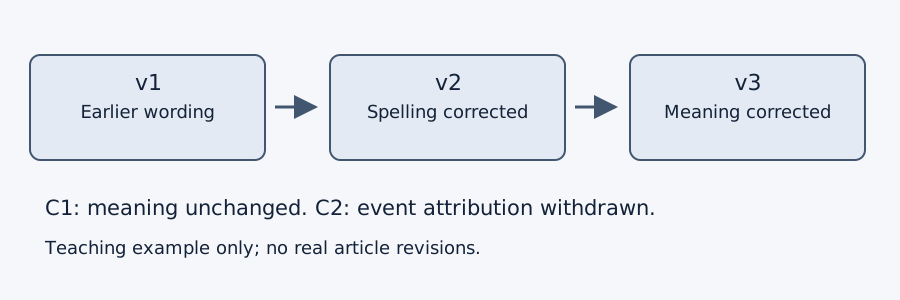
The following entry names, versions, times, and evidence references are invented for teaching. They do not describe an actual article or completed review. Assume a fictional article called “Example scene note,” which maintains versions v1, v2, and v3.
Entry C1: a spelling correction
- Correction time: 2026-09-22, 09:00 UTC
- Affected version: v1
- Earlier wording: “obersvation interval”
- Current wording: “observation interval”
- Reason: a misspelled word in the timing paragraph
- Affected material: that paragraph only
- Consequence: no change to the interval, evidence, or interpretation
- Current version: v2
This small correction is included to make the exercise easy to compare. A publisher may handle routine typographical fixes differently under its own policy. What matters is not to classify a changed factual meaning as typography merely because the edit is short.
Entry C2: a corrected time interpretation
- Correction time: 2026-09-22, 11:30 UTC
- Affected version: v2
- Earlier claim: “The image was acquired at 09:10 UTC”
- Current claim: “The page was retrieved at 09:10 UTC; the acquisition interval is not established in the material reviewed”
- Reason and source: in this fictional record, the saved retrieval log establishes what 09:10 refers to; no reviewed source establishes acquisition time
- Affected material: the timing paragraph, figure 1 caption, and comparison table
- Consequence: the claim that the image shows a particular launch attempt is withdrawn pending acquisition evidence
- Current version: v3
- Remaining uncertainty: which observation interval the image represents
The second change cannot be summarized honestly as a timestamp typo. It changes the basis for linking the image to an event. The entry shows the dependency between the corrected field and the conclusion that relied on it.
Explain whether the source or the article changed
A source may issue a new finding; a writer may discover that the source was misread; or a transcription error may have entered the article. Name the situation that actually occurred. Do not blame an upstream source for an error introduced during your own interpretation.
Also distinguish a correction from an update. In this proposed design, a correction identifies something previously wrong or misleading. An update adds later information and explains whether it changes the earlier account. Some changes need both descriptions. Use an informative reason rather than a vague “new information” label that hides an earlier error.
When the source itself has a correction notice or version history, link to it. The article’s log should still explain the effect on the article; an external link alone leaves readers to reconstruct that consequence.
Check the places readers may already be using
For each material correction, inspect the headline, summary, body, captions, tables, downloadable material, and relevant internal references. List the affected locations and their actual status. “Update required” is an honest status when a copy has not yet been corrected. Do not mark every location complete because the main paragraph is fixed.
This checklist describes a proposed editorial check. It does not authorize third-party messages or guarantee that external copies can be changed. If a derivative article is outside your control, record that limit and use the applicable editorial policy to decide what communication is appropriate.
Preserve enough of the earlier claim to explain the change, but avoid unnecessarily republishing private data or harmful material. Where repeating the exact wording would create a new problem, a careful description of the error and the corrected fact may serve readers better.
Keep the current answer readable
A correction log should support the article rather than compete with it. Give readers the current claim where they expect to find it, then make the meaningful change discoverable. Avoid a maze of unlabeled “latest” links or version numbers that have no explanation.
The source-linked evidence brief helps organize the underlying claim and source record. The launch-claim verification guide helps reassess a claim whose support has changed. The log’s specific job is to tell the reader what changed, why it changed, and what that means for the conclusion they are reading now.