Launch Watch · Spaceflight
Published
Saturn’s two 2025 crossings: Earth on March 23, the Sun on May 6
Separate viewing geometry from illumination using 4,345 hourly Saturn samples, with two zero-crossing brackets and a downloadable model-data table.
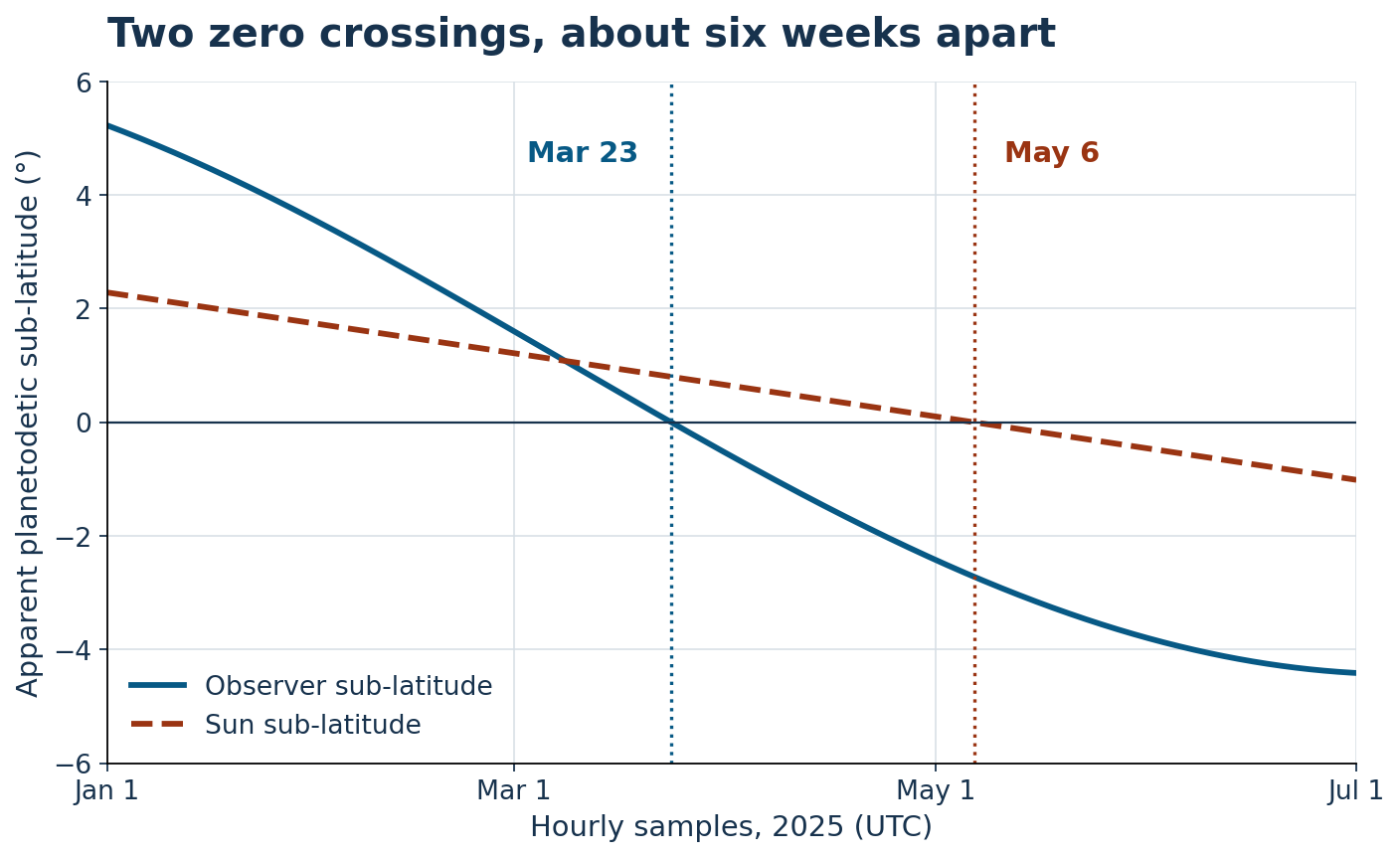
Two dates attached to Saturn’s rings in 2025 describe different alignments. March 23 is the Earth-viewing ring-plane crossing; May 6 is the solar-equinoctial crossing. They are about six weeks apart.
We checked that distinction in 4,345 hourly JPL Horizons samples. The observer’s apparent sub-latitude crosses zero on March 23, while the Sun’s apparent sub-latitude crosses zero on May 6. Following one curve does not establish when the other crosses.
Who is in the plane: the observer or the Sun?
A viewing-plane crossing describes the line from Saturn to the observer approaching the equatorial plane, where the main rings lie. Equinox describes the Sun passing through that plane and changing which side it illuminates.
Earth and the Sun occupy different directions as seen from Saturn. Their alignments therefore need not occur on the same date. A ring-season headline is clearer when it names whether it concerns the observer’s view or the illumination.
An archived NASA Hubble article lists March 23, 2025 as a future Earth ring-plane crossing and places Saturn only about 10 degrees from the Sun. An ESA equinox article gives May 6, 2025 for the solar event. Those are published predictions in older explanatory material; the calculation below is a separate retrospective check against a retained ephemeris.
Read the sign changes directly
| UTC sample | Observer sub-latitude (°) | Sun sub-latitude (°) | Sun–Saturn separation (°) |
|---|---|---|---|
| 23 Mar 2025, 17:00 | +0.002251 | +0.801978 | 10.0091 |
| 23 Mar 2025, 18:00 | −0.000635 | +0.801219 | 10.0447 |
| 6 May 2025, 15:00 | −2.720015 | +0.000445 | 47.9617 |
| 6 May 2025, 16:00 | −2.722160 | −0.000317 | 47.9980 |
On March 23, the observer column changes from positive to negative between 17:00 and 18:00 UTC. The Sun column is still about +0.8 degrees. On May 6, the Sun column changes sign between 15:00 and 16:00, while the observer column is already about −2.72 degrees.
Keep the coordinate names attached
Horizons labels these fields as apparent planetodetic sub-latitudes. We retain that terminology instead of relabeling the entire curves as generic “ring-opening angles.” The model’s body orientation and light-time conventions belong to the definition.
The zero crossings provide a useful plane-alignment comparison. The off-zero values should not be treated as an independent measurement of ring thickness, brightness or every warped structure in the ring system. A numerical latitude curve also does not show rings physically disappearing.
Although interpolation could produce a minute within each one-hour bracket, we report date-level conclusions. Extra decimal places in an interpolation would not remove dependence on the orientation model and apparent-coordinate conventions.
The March date was not an automatic observing opportunity
The table puts the March bracket at roughly 10 degrees of apparent solar separation. That is important context for the date, not a telescope-pointing instruction. A geometrically interesting alignment can be poorly placed for observation from Earth.
This article provides no visibility or brightness forecast. Do not use these data to aim optical equipment near the Sun. A safe observing plan requires different, location-specific information and appropriate precautions.
Reproduce the two-column test
The 4,345-row CSV covers January 1 through July 1, 2025, including the final endpoint. For each sub-latitude column, inspect successive rows and find where the sign changes. The two columns each have one such bracket in the retained interval.
The exact Horizons request selects Saturn center, target 699, viewed from Earth center, 500@399, with hourly observer quantities 14, 15 and 23. The source response was retained on October 5, 2026. These are modeled apparent coordinates, not a set of telescope observations.
Sources and chart credit
- JPL Horizons manual, for sub-observer and sub-solar coordinates and apparent conventions.
- NASA Hubble ring-plane-crossing explanation, including the March date and solar separation.
- ESA: Saturn at equinox, for the May date.
Original chart and sign-change analysis: LaunchDetect. Ephemeris: JPL Horizons. No NASA, ESA or Cassini imagery is reproduced, and no agency endorsement is implied.