Launch Watch · Launch Watch · Evidence study
Published
Five Shuttle pad aborts show why ignition and liftoff are separate events
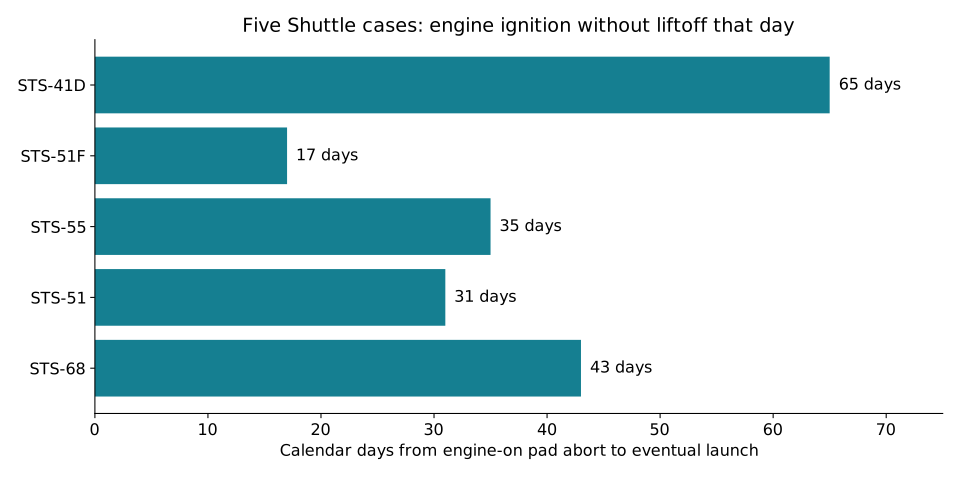
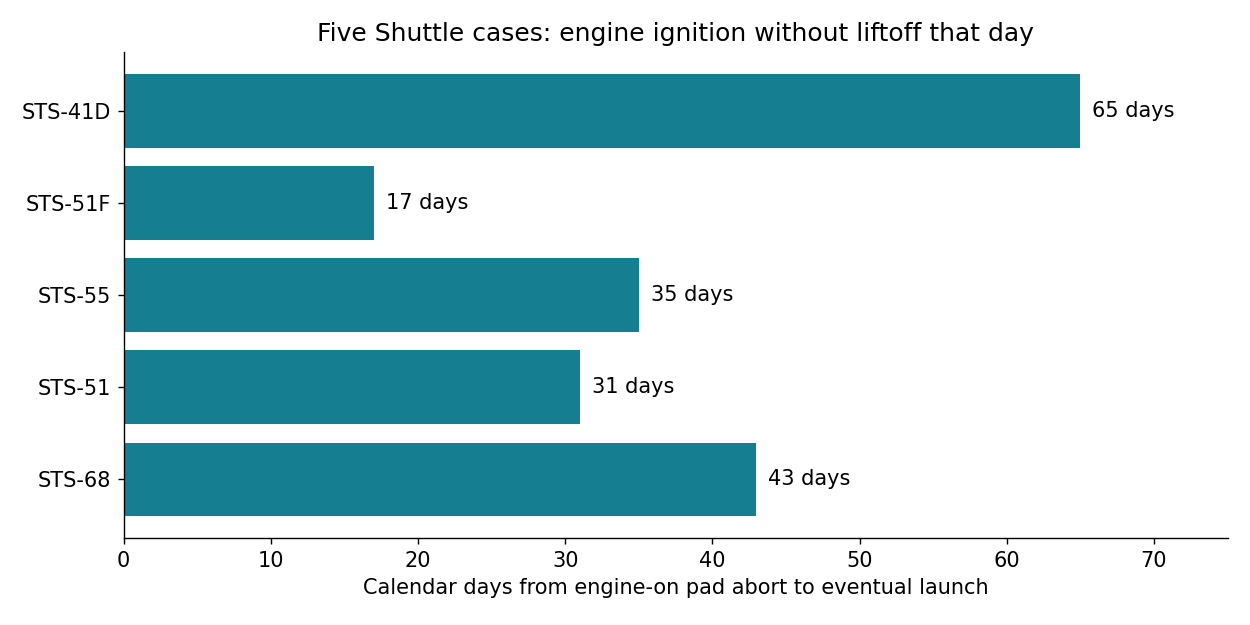
NASA records five Shuttle pad aborts after main-engine ignition. Their eventual launches came 17–65 calendar days later, showing why engine-on and liftoff need separate records.
On 26 June 1984, two of Discovery’s main engines ignited during the STS-41D countdown. The attempt stopped on the pad. The mission eventually launched on 30 August, 65 calendar days later.
NASA’s historical account identifies five Shuttle pad aborts after at least one main engine ignited. Each is a concrete example of why evidence of engine operation and evidence of liftoff belong in separate fields.
Open full-size figure · Download PNG figure
The five cases, with both dates preserved
We paired the dated abort cases in NASA’s Shuttle pad-abort retrospective with eventual launch dates from the final Kennedy Space Center 135-flight history chart. The resulting table contains two events for each mission, rather than allowing its successful later launch to overwrite the earlier outcome.
| Mission | Engine-on pad abort | Eventual launch | Calendar-day gap |
|---|---|---|---|
| STS-41D | 1984-06-26 | 1984-08-30 | 65 |
| STS-51F | 1985-07-12 | 1985-07-29 | 17 |
| STS-55 | 1993-03-22 | 1993-04-26 | 35 |
| STS-51 | 1993-08-12 | 1993-09-12 | 31 |
| STS-68 | 1994-08-18 | 1994-09-30 | 43 |
The gaps range from 17 days for STS-51F to 65 for STS-41D, with a median of 35 days. Those are civil-calendar differences. They are not exact elapsed hours, repair durations or a forecast of how long a modern launch delay will last.
“Engine ignition” also needs a careful definition
The five cases do not all imply that every main engine completed a normal startup. For STS-41D, two engines ignited while the first did not. The common feature of the set is that at least one main engine ignited before the attempt was stopped without liftoff.
That is a useful event-state distinction. “Countdown underway,” “engine startup,” “liftoff” and “flight outcome” should not be compressed into a single Boolean launch flag. A source can support one state without establishing the next.
The table intentionally avoids fine countdown tenths. NASA accounts differ in rounded timing for some cases, and that extra precision is unnecessary to establish the sequence. The dated outcomes provide the evidence needed for the article’s question.
STS-51F had two different kinds of abort
STS-51F’s mission history includes the 12 July 1985 pad abort and a later abort-to-orbit during the flight that launched on 29 July. The first event occurred before liftoff; the second was an in-flight outcome.
A search result or database entry containing only “STS-51F abort” can therefore be ambiguous. Adding the date, mission phase and outcome resolves which event is meant. It also avoids using a later in-flight account as evidence for an earlier pad event.
Reproduce the dates without inventing a cause
We transcribed the five RSLS pad-abort dates from NASA’s retrospective, cross-checked available mission histories and joined each mission identifier to its eventual launch date in the KSC chart. All five joined dates must match the flight-history record.
For each pair, subtract the local abort calendar date from the local launch calendar date. The CSV preserves both endpoints, the calendar-day separation and a short engine-state note. It does not turn the gap into a measure of work performed on the vehicle.
The interval can include operational decisions and other intervening circumstances. The source records and subtraction alone cannot assign every day of delay to repairs caused by the abort.
What this means for detection evidence
The cases demonstrate that ignition and liftoff are different events. They do not demonstrate that a particular historical abort was detected by a weather satellite. No satellite measurement or signal-strength analysis is supplied here.
Likewise, five historical cases cannot estimate a modern detection system’s false-positive rate. To make that claim, one would need an actual defined test set and measured detection outcomes.
The practical lesson is about keeping an evidence log honest: record what the source establishes, preserve the event’s phase and date, and verify liftoff independently when that is the claim being made. A later successful launch should remain linked to the earlier attempt, with its own outcome.
Sources and data
Source snapshots were retrieved on 6 October 2026. The observation dates and product versions are stated above; retrieval does not make a historical record current.