Launch Watch · Launch Watch · Evidence study
Published
28 backward steps in Shuttle mission numbers: sort by launch date
A NASA flight-history audit finds 28 mission-number reversals in 110 Shuttle flights. Preserve the mission label, then sort by the dated launch record.
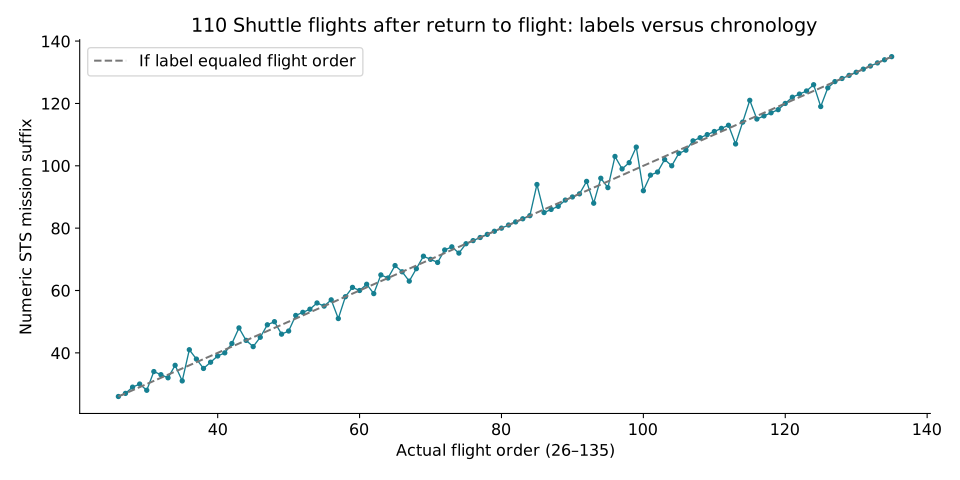
STS-30 launched on 4 May 1989. STS-28 followed on 8 August. Sorting those two flights by the number after “STS” would put them in the wrong order. Across NASA’s 110 flights from STS-26 through STS-135, we find 28 adjacent pairs in which the mission number goes backward while the launch chronology moves forward.
This matters whenever you build a timeline, join a photograph to a mission or compare Shuttle launches with another dated record. A mission label identifies the flight. A separate launch-date field establishes when it happened.
Open full-size figure · Download PNG figure
A sequence you can check by eye
The first ten flights in the selected era have suffixes 26, 27, 29, 30, 28, 34, 33, 32, 36 and 31. The reversals are visible before any summary statistic is calculated. STS-28 is the fifth flight in this ten-flight sequence, despite its smaller suffix.
| Flight order | Mission label | Launch date |
|---|---|---|
| 26 | STS-26 | 1988-09-29 |
| 27 | STS-27 | 1988-12-02 |
| 28 | STS-29 | 1989-03-13 |
| 29 | STS-30 | 1989-05-04 |
| 30 | STS-28 | 1989-08-08 |
| 31 | STS-34 | 1989-10-18 |
| 32 | STS-33 | 1989-11-22 |
| 33 | STS-32 | 1990-01-09 |
| 34 | STS-36 | 1990-02-28 |
| 35 | STS-31 | 1990-04-24 |
The largest adjacent numerical drop in the selected era is from STS-106, launched on 8 September 2000, to STS-92, launched on 11 October 2000. The suffix decreases by 14. That is a difference between identifiers, not a 14-flight gap or a measure of how long either mission was delayed.
What the count of 28 includes
We started with NASA’s final Kennedy Space Center 135-flight Shuttle history chart. All 135 mission labels and their launch dates are retained in the downloadable data. For the numerical comparison, we select the 110 flights beginning with STS-26 on 29 September 1988.
That choice avoids forcing early alphanumeric mission labels into a numerical test. It also fixes the scope of the result: 28 is the count for this post-return-to-flight numerical era, not a universal statistic for every Shuttle naming convention.
After sorting by launch date, we compare each suffix with the previous flight’s suffix. A pair contributes one reversal when the later flight has the smaller number. The accompanying reversal CSV preserves every counted pair and both dates. The chart instead plots mission suffix against actual flight order, making each downward step visible.
A reliable way to build a Shuttle timeline
- Keep the complete mission identifier as text. Do not replace it with a row number.
- Extract the launch date from the flight-history record and preserve the date basis.
- Sort on that launch date, then assign a separate chronological rank.
- Use mission labels as identifiers when joining records. Check the source date when a timeline or image caption depends on order.
For this audit, the extraction takes the first printed launch date associated with each mission entry. We require 135 unique mission labels before selecting the 110-flight subset. The original chart can have multiple columns, so PDF text-extraction order is not accepted as chronological order.
Two limits worth keeping beside the data
First, the source explicitly uses Eastern Standard or Daylight local dates. These are one-day calendar labels, not UTC timestamps. When matching another database or satellite observation, retain that distinction rather than silently relabeling midnight boundaries.
Second, a numbering reversal does not identify its cause. The chart and this arithmetic alone cannot establish why a mission flew later than a smaller-numbered one. That question needs mission-specific records.
A clean summary is: “Among the 110 Shuttle flights from STS-26 through STS-135, 28 consecutive launch pairs have descending numerical mission suffixes.” It names the set, the unit being counted and the comparison.
Sources and data
Source snapshots were retrieved on 6 October 2026. The observation dates and product versions are stated above; retrieval does not make a historical record current.
Download B440_all_missions.csv (CSV) · Download B440_suffix_reversals.csv (CSV)