Why spacecraft carry different kinds of antennas
A spacecraft drawing may show a large dish and several much smaller antennas. It is tempting to treat the dish as the good one and the others as leftovers. A more useful reading is that the spacecraft has different communication needs, and one antenna pattern may not suit all of them.
High-gain and low-gain describe how an antenna concentrates its response by direction. A high-gain antenna generally puts more emphasis into a narrower beam. A low-gain design offers broader angular coverage. NASA’s spacecraft communications overview lays out this directional tradeoff.
Gain is about direction, not a new supply of power
For transmission, imagine the same available radio power distributed in two different patterns. Concentrating it toward the intended receiver can make the signal stronger there than spreading it widely. The antenna has not created additional transmitter power.
NASA’s telecommunications chapter explains how a spacecraft dish focuses radio energy toward Earth. This is why transmitter power and antenna gain are separate entries in a communication-system description. A large gain number alone cannot tell you the spacecraft’s electrical consumption or the speed of an image download.
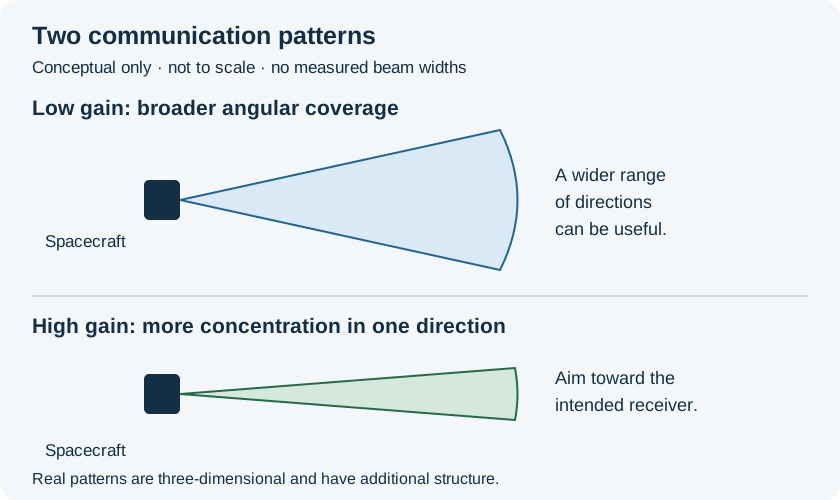
Original conceptual diagram, not measured antenna patterns or a Psyche hardware drawing. The broad fan represents more angular coverage; the narrow fan represents greater concentration toward a selected direction. Real patterns are three-dimensional and have additional structure.
The tradeoff shows up when you have to point
A concentrated beam is useful only when the intended receiver lies within the useful part of it. Pointing therefore matters. NASA’s SmallSat communications chapter describes choices including moving an antenna on a gimbal and changing the spacecraft’s orientation to point a body-mounted antenna.
A broad pattern can make communication less sensitive to exact orientation. NASA’s ground-systems discussion gives a practical reason: just after separation from a launch vehicle, a small spacecraft may not yet have full control of its attitude, so broad receiving coverage is valuable. That is a general design example, not a claim about which antenna a particular spacecraft is using today.
| Question to ask | Broad-coverage, low-gain design | Narrow-beam, high-gain design |
|---|---|---|
| What advantage does the pattern offer? | More freedom in the direction from which a link can be maintained | Greater concentration toward a selected direction |
| What deserves attention in the mission description? | Whether the published pattern and spacecraft arrangement cover the needed directions | How the antenna is aimed and how accurately that aim must be maintained |
| What remains a separate question? | Whether this link can support the required data rate at the relevant distance | Whether the rest of the radio and ground system can use the directional advantage |
This comparison explains a choice, not a ranking. “Low gain” does not mean defective, and “high gain” does not specify one universal data rate. Distance, radio power, the ground receiver, coding and other link conditions matter too. NASA’s space-communications guide discusses several of these constraints.
Read Psyche’s antenna inventory without inventing its operating mode
NASA’s Psyche spacecraft page lists four antennas: one fixed, two-meter high-gain antenna and three small low-gain antennas. It also identifies the Deep Space Network as the route for mission data and commands.
That short inventory supports several useful observations. Psyche carries both antenna categories. The large antenna is described as fixed. There are three low-gain antennas, rather than one. Those are documented hardware facts.
Now pause before adding a story the inventory does not supply. It does not show which antenna is active at the moment you are reading, the current transmission rate, or the reason for any interruption. A photograph also does not establish those operating details.
Try this original reading exercise with any mission fact sheet:
- Copy the inventory. Record each antenna category, count and any stated dimension. Keep words such as “fixed” attached to the right item.
- Separate the functions. Underline the text that explicitly describes sending data, receiving commands or another role. Leave unstated assignments open.
- Find the pointing explanation. Look for a source describing how the antenna or spacecraft is oriented. Do not infer it solely from the dish’s appearance.
- Mark the date and scope. A hardware overview and a dated operations update answer different questions.
- Write one bounded conclusion. For Psyche, “NASA lists both high-gain and low-gain antennas” is supported. A claim about today’s selected link needs an operations source.
For another spacecraft architecture, our Starlink explainer introduces communication roles while keeping generation differences visible. Antenna labels become more useful when they remain attached to the mission and hardware version they describe.
Sources
Primary pages checked October 3, 2026. No live spacecraft operating mode was determined for this article.