Launch Watch · Launch Watch · Evidence study
Published
For 33 of 53 Swift bursts, the measured T90 interval began before the trigger
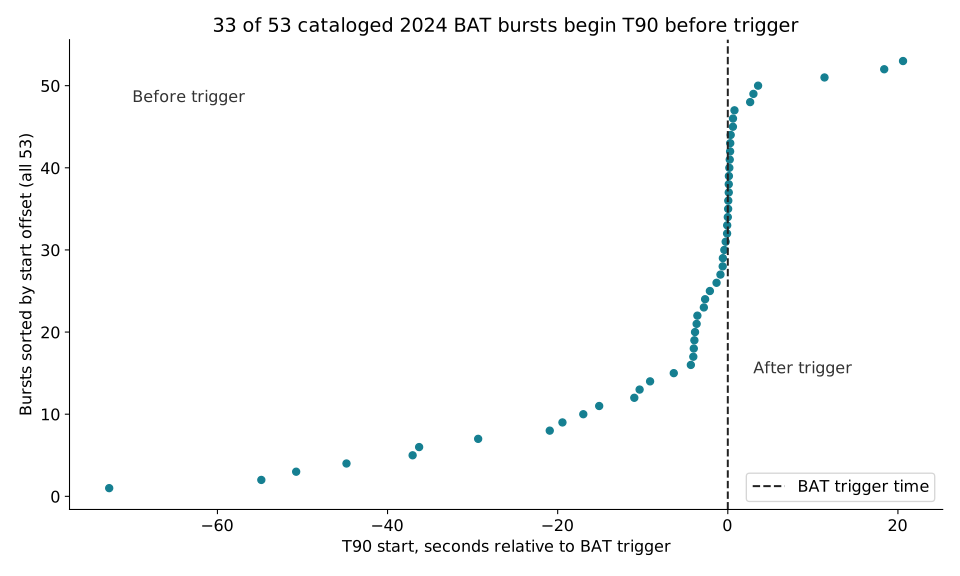
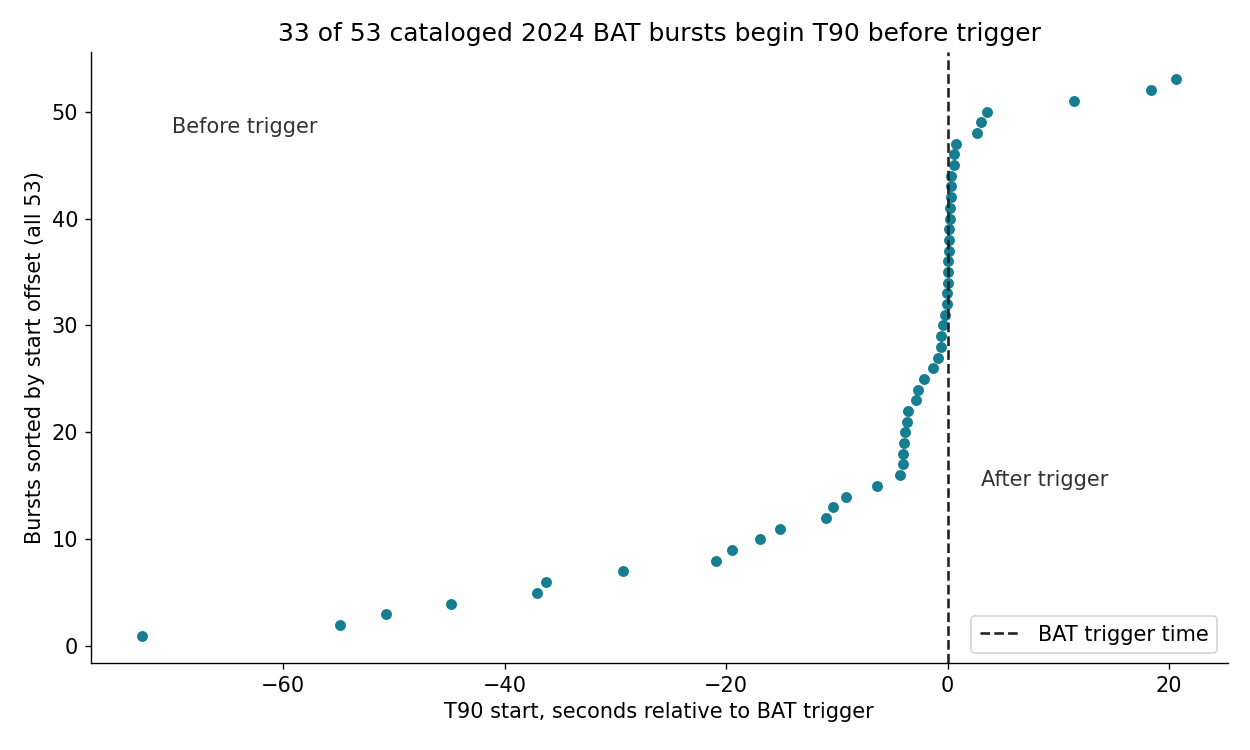
In 53 cataloged 2024 Swift BAT bursts, 33 T90 intervals begin before the trigger. A trigger timestamp and a retrospectively measured event interval serve different roles.
For 33 of the 53 Swift BAT bursts in our selected 2024 catalog sample, the measured T90 interval begins before the catalog’s trigger time. That negative offset is easy to misread if the trigger is assumed to mark the first photons from an event.
The catalog retains separate times for the detector trigger, the measured count interval and the available event-data window. Comparing them shows why a trigger timestamp is a reference point rather than a universal event-start clock.
Open full-size figure · Download PNG figure
What T90 measures here
In the Swift BAT catalog analysis, T90 is the observer-frame interval containing the central 90% of the relevant burst counts in that analysis. It is not the complete lifetime of the physical source, and it is not a measure of the photons’ travel time to Earth.
The duration table expresses interval boundaries in seconds relative to the trigger. A negative start therefore means the measured interval begins before that reference timestamp. Stored event data can include pre-trigger times, allowing later analysis to measure such an interval.
| Trigger method | Valid T90 intervals | T90 starts before trigger | T90 ends before trigger |
|---|---|---|---|
| Rate | 50 | 32 | 0 |
| Image | 3 | 1 | 0 |
| Total | 53 | 33 | 0 |
Walk through one catalog row
GRB241229B provides a compact example. Its T90 interval starts 2.108 seconds before the trigger and ends 2.940 seconds after it. Subtracting −2.108 from 2.940 gives 5.048 seconds, the cataloged T90 duration.
For this example, the Swift-BAT team’s GCN 38721 report explicitly gives T90 in the 15–350 keV band as 5.05 ± 0.65 seconds, consistent with the rounded catalog duration. The individual catalog report also preserves the interval bounds. This event-specific band check is not an independent audit of every event’s data headers.
The same row’s retained event-data window extends from −240 to +962 seconds relative to the trigger. That wider window is a data-availability interval, not another estimate of the burst duration. Keeping the two intervals in separate columns prevents a long stored window from being mistaken for a long burst.
This example illustrates the bookkeeping; the summary does not rely on selecting unusually early starts. The figure plots all 53 T90 start offsets, sorted from earliest to latest, and the CSV retains every selected row.
What the full sample shows
The sample contains 50 rate-triggered bursts and three image-triggered bursts. Thirty-two rate-triggered and one image-triggered interval start before the trigger. None of the 53 intervals ends before the trigger, so this selected year does not provide an example with its entire T90 interval preceding the trigger.
The counts use the signs of the catalog’s published central interval estimates. Some offsets lie very close to zero; a small negative value is not, by itself, an uncertainty-aware finding that the interval began significantly earlier. Duration errors remain in the CSV, and this audit does not test significance for individual onset estimates.
These group sizes do not justify a causal comparison of trigger methods. Three image triggers and 50 rate triggers are not a randomized experiment, and this catalog subset is not all bursts in the universe. The calculation is an interval audit, not a trigger-efficiency estimate.
Join on identity, then validate the duration
We join the catalog’s general-information and burst-duration tables by GRB name and select names beginning GRB24. Each retained row must have finite interval boundaries and positive duration. For all 53 rows, T90 stop minus start must agree with the general table’s duration within 0.002 seconds.
We then count starts below zero and stops below zero separately. This matters because “starts before trigger” and “finishes before trigger” are different claims. The public data preserve duration errors, trigger method, event-data boundaries and catalog comments alongside the offsets.
The analysis definitions follow the Swift/BAT team’s catalog documentation and Lien et al. (2016), linked below. The figures and joined interval tables are original calculations from the public numerical catalog.
A timestamp needs a role
Negative relative seconds do not mean an alert arrived before the photons it concerns. They mean the reference timestamp and the retrospectively measured interval have different roles. Before reusing any event timestamp, ask whether it marks a physical observation, an automatic trigger, a retained-data boundary or a later analysis product.
For this sample, the supported statement is precise: 33 of 53 valid 2024 catalog T90 intervals start before their BAT trigger, and none ends before it. Keeping both halves avoids turning a useful timing distinction into a more dramatic claim than the data support.
Sources and data
Source snapshots were retrieved on 6 October 2026. The observation dates and product versions are stated above; retrieval does not make a historical record current.
- swift general.txt
- swift duration.txt
- swift tables.html
- swift catalog.html
- swift catalog paper.pdf
- Official batgrbproduct analysis help
- Swift-BAT GRB 241229B refined analysis, GCN 38721
- GRB 241229B catalog event report
Download B445_swift_2024_trigger_intervals.csv (CSV) · Download B445_swift_chart_selection.csv (CSV)