Launch Watch · Spaceflight
Published
Voyager at Jupiter: why 350,000 km and 280,000 km can describe one flyby
Audit Voyager’s Jupiter flyby distances by keeping center distance, cloud-top altitude and each archive’s Jovian-radius definition separate.
Voyager 1 passed Jupiter at roughly 350,000 kilometers from the planet’s center, according to NASA’s Deep Space Network history. A NASA instrument archive puts the encounter about 280,000 kilometers above the cloud tops. The roughly 70,000-kilometer gap is the scale of Jupiter’s radius, so the first question to ask is where each distance starts.
The archive records let us check that explanation for both Voyagers. They also expose a smaller trap: two NASA pages use different numerical definitions of a Jovian-radius unit. Mixing those definitions shifts a conversion by thousands of kilometers even before the center-versus-cloud-top question is addressed.
Two endpoints make a distance
The NASA history Uplink-Downlink explicitly describes Voyager 1’s Jupiter encounter as about 350,000 kilometers from the planet center on printed page 173. The Voyager magnetometer archive explicitly describes its approximately 280,000-kilometer distance from the cloud tops.
Those are different reference points for the same flyby. “Distance from Jupiter” drops the words that distinguish them. For a caption or a comparison table, retain “from the center” or “above the cloud tops” alongside the number.
Convert the archived radius values using their own definition
The NSSDCA closest-approach table gives 4.89 Jovian radii for Voyager 1 and 10.11 for Voyager 2. Its note defines one Jovian radius, Rj, as 71,398 kilometers. Multiplication gives 349,136.22 and 721,833.78 kilometers respectively.
Those decimals are arithmetic output from rounded archive inputs. In ordinary prose, about 349,000 and 722,000 kilometers better reflect the precision of the starting values. The separately published cloud-top figures remain in their own column.
| Spacecraft | Archive distance | Derived center distance, rounded | Published cloud-top altitude |
|---|---|---|---|
| Voyager 1 | 4.89 Rj | 349,000 km | 280,000 km |
| Voyager 2 | 10.11 Rj | 722,000 km | 650,000 km |
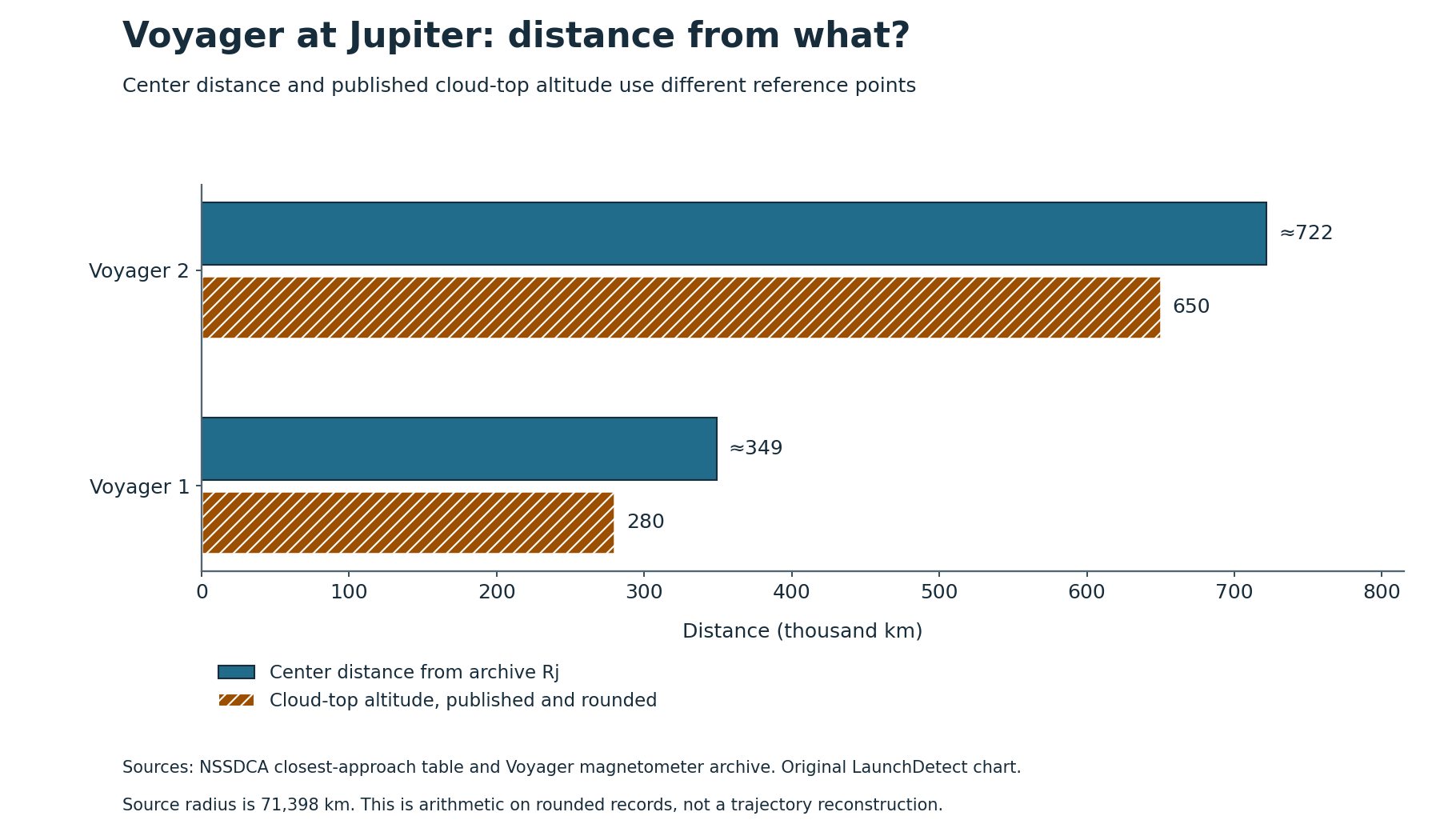
The table dates the encounters to March 5 and July 9, 1979. Its time note specifically uses spacecraft UTC. This article does not mix those event times with Earth receipt times or attempt to resolve time-of-day differences in other historical narratives; the comparison concerns the distance definitions.
A spherical calculation checks the scale of the explanation
As a simple illustration, subtract one 71,398-kilometer source radius from each converted center distance. Equivalently, multiply one less than the archive’s Rj value by that same radius.
| Spacecraft | Center distance minus one source radius | Spherical illustration, rounded | Published cloud-top figure |
|---|---|---|---|
| Voyager 1 | (4.89 − 1) × 71,398 | 278,000 km | 280,000 km |
| Voyager 2 | (10.11 − 1) × 71,398 | 650,000 km | 650,000 km |
For Voyager 1, the unrounded result is 277,738.22 kilometers, about 2,262 kilometers below the separately reported 280,000-kilometer cloud-top figure. For Voyager 2, it is 650,435.78 kilometers, about 436 kilometers above the reported 650,000 kilometers.
These residuals should remain visible. The subtraction accounts for the large reference-point difference, but it does not force the two sources into an exact match. Jupiter is not a sphere, its cloud tops are not a hard physical surface, and the input distances are rounded archival summaries. A shape-aware reconstruction would need additional geometry and trajectory information.
This is why the converted values and the published cloud-top values should not be merged into one “corrected” column. The former are our calculations using a specific archive convention. The latter are facts reported separately by the instrument archive.
The Rj label also needs a numerical definition
In its coordinate-system description, the magnetometer archive defines its radial unit as 71,942 kilometers. That is 544 kilometers, or about 0.762%, larger than the 71,398 kilometers specified in the NSSDCA encounter table. Neither page’s unit definition should be silently replaced by the other’s.
To show the effect, keep the encounter table’s 4.89 and 10.11 multipliers but substitute 71,942 kilometers. This deliberately mixed-source calculation yields the following values. It is an error demonstration, not a recommended correction.
| Spacecraft | Using 71,398 km | Using 71,942 km | Change, rounded |
|---|---|---|---|
| Voyager 1 | 349,136 km | 351,796 km | 2,660 km |
| Voyager 2 | 721,834 km | 727,334 km | 5,500 km |
The unit difference is multiplied by the distance expressed in radii: 4.89 × 544 gives 2,660.16 kilometers; 10.11 × 544 gives 5,499.84 kilometers. That is large enough to spoil a seemingly careful comparison assembled from individually authoritative pages.
The evidence here does not establish why the definitions differ. It is insufficient to label either one a typo. The defensible approach is to record the numerical radius beside the multiplier and preserve that pairing throughout the calculation.
Method and limits
The distance-audit CSV preserves the two archive multipliers, both stated radius definitions, the separately published cloud-top values, and all the arithmetic results. To reproduce it, multiply each encounter-table value by 71,398, subtract 71,398 for the spherical illustration, then repeat the multiplication with 71,942 for the source-mixing test.
We have not integrated a Voyager trajectory, processed SPICE kernels or solved an altitude above an oblate cloud surface. The residuals are differences between this simple illustration and rounded published descriptions. Their displayed calculation precision should not be mistaken for spacecraft-position accuracy.
For these Jupiter encounters, a compact comparison needs four fields: spacecraft, distance, reference point and radius convention where relevant. That makes the familiar 350,000-versus-280,000 question answerable without inventing a change in Voyager 1’s flyby or hiding the smaller differences that remain.
Sources
- NASA NSSDCA: Voyager closest-approach distances and times. Jupiter: 4.89 Rj and 10.11 Rj; footer defines Rj as 71,398 km.
- Voyager magnetometer archive: planetary encounters and coordinates. Encounter-date section explicitly gives 280,000 and 650,000 km above cloud tops; coordinate section defines a Jovian-radius unit of 71,942 km.
- NASA: Voyager 1 mission overview. Jupiter closest approach prose gives March 5, 1979 and 280,000 km.
- NASA SP-4227: Uplink-Downlink, A History of the Deep Space Network. Printed p.173; PDF page214 one-based. Only center-distance fact used.
Charts and calculations: LaunchDetect, using the linked factual records. No NASA or JPL endorsement is implied.