Launch Watch · Dashboard evidence
Published
Aircraft and vessel layers keep their own clock during thermal replay
A Transporter 18 dashboard test compares an October 1 thermal replay with October 6 aircraft and vessel snapshots across three inspected frame selections.
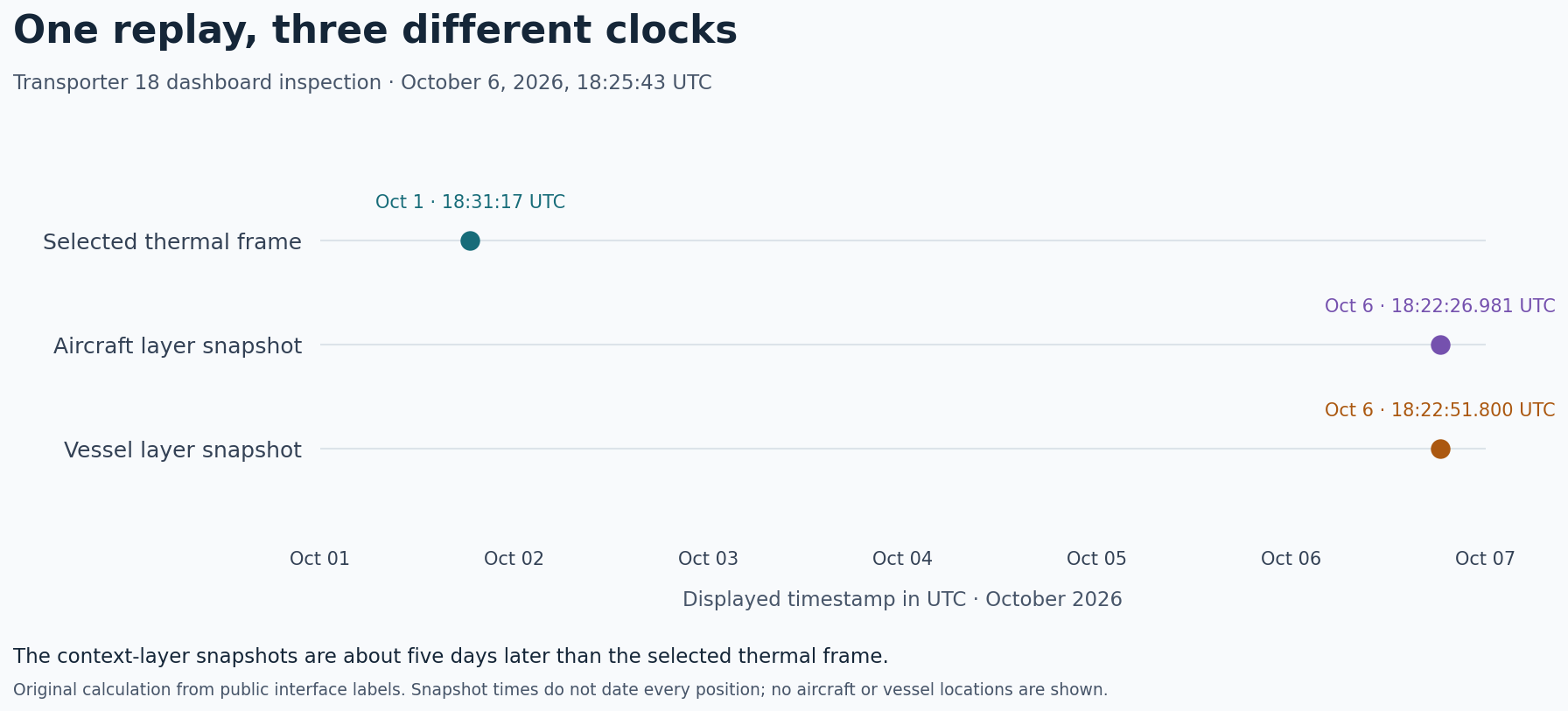
Selecting a historical thermal frame does not make every enabled LaunchDetect layer historical. In a signed-out dashboard inspection on 6 October 2026, Transporter 18’s selected image carried an acquisition time of 1 October at 18:31:17 UTC. The Aircraft and Vessels panels each showed a snapshot from 6 October.
That distinction matters when preparing a retrospective launch illustration. A context layer visible beside a replay cannot, by itself, place those aircraft or vessels in the launch scene at the image’s acquisition time. This case checks the displayed clocks and changes the replay selection to see which labels move.
Start with three labeled timestamps
We opened the public dashboard, selected Transporter 18, and enabled Aircraft and Vessels under Layers and legend. The selected mission is also identified by its permanent public report.
At 18:25:43 UTC on 6 October, the interface exposed these three times:
| Clock | Displayed timestamp, UTC | Meaning of the displayed field |
|---|---|---|
| Selected thermal frame | 1 Oct 2026, 18:31:17 | Acquisition label of the selected image |
| Aircraft layer snapshot | 6 Oct 2026, 18:22:26.981 | Timestamp attached to the layer’s latest snapshot |
| Vessel layer snapshot | 6 Oct 2026, 18:22:51.800 | Timestamp attached to the layer’s latest snapshot |
Both context panels explicitly said, “This layer does not follow replay time.” Their timestamps used a trailing Z, which denotes UTC; the image label explicitly named UTC. The separate local clock in the page header was not used in this comparison.
The Aircraft panel listed 102 positions; Vessels listed 3,273. These are displayed snapshot counts. They do not establish the number of vehicles near the launch, the number present on 1 October, or complete global coverage. A snapshot timestamp also does not establish that every position within it was observed at that same instant.
Move the replay and compare again
We then chose the first and last frames of the same 39-frame replay. The image acquisition label changed while the two context snapshot labels and their displayed counts stayed the same during these checks.
| Inspection time | Thermal selection | Acquisition on 1 Oct | Aircraft snapshot | Vessel snapshot |
|---|---|---|---|---|
| 18:25:43 | Recorded detection, frame 22 of 39 | 18:31:17 | 6 Oct, 18:22:26.981 | 6 Oct, 18:22:51.800 |
| 18:26:08 | First frame, 1 of 39 | 16:46:17 | 6 Oct, 18:22:26.981 | 6 Oct, 18:22:51.800 |
| 18:26:37 | Last frame, 39 of 39 | 19:56:17 | 6 Oct, 18:22:26.981 | 6 Oct, 18:22:51.800 |
The first-to-last image span in this test is 190 minutes. The observed result agrees with the interface’s warning: moving the thermal selection did not retime those context labels. It does not establish a permanent update interval or guarantee that context snapshots never refresh during a longer session.
Calculate the separation without changing its meaning
For the initially selected 18:31:17 thermal frame, subtracting the acquisition label from the aircraft snapshot label gives 4 days, 23 hours, 51 minutes and 9.981 seconds. The vessel difference is 4 days, 23 hours, 51 minutes and 34.800 seconds.
Those are differences between labeled timestamps. They are useful for spotting the nearly five-day separation in this display. They are not measurements of transmission delay, position age for each vehicle, or launch-detection latency. The downloadable audit table preserves all three selections and the arithmetic’s endpoints.
Prepare a time-consistent illustration
Before using a replay in a briefing, record the selected image time and inspect each enabled context layer’s own timestamp and source. For a retrospective illustration, turn off a layer whose date does not support the historical claim, or clearly label its separate date and purpose. A historical traffic reconstruction requires suitable time-matched records and evidence about their completeness.
The dashboard attributed the aircraft layer to ADS-B via adsb.lol and the vessel layer to AIS via aiscast/openwaters.io, with contributing sources named in the interface. This audit uses only the public timestamp and count labels. It redistributes no traffic records, identifiers, coordinates, satellite images or dashboard screenshots. The site’s credits and terms keep third-party reuse conditions separate from public access.
The cloud browser’s Cesium/WebGL globe did not initialize. The textual panels and thermal selection controls were usable, so this inspection verifies their labels and the three selection changes. It makes no claim that mapped aircraft or vessel positions, geometry, or simultaneous scene overlap were tested.
A useful handoff keeps the mission identity, selected frame, each layer’s date and the inspection time together. In this case, that record is enough to prevent an October 6 context snapshot from being described as traffic observed during the October 1 thermal frame.
Sources and method
- LaunchDetect public dashboard, signed-out cloud-browser inspection on 6 October 2026, 18:25:43–18:26:37 UTC.
- Transporter 18 permanent report, event ld-fabae6decd17ae7f.
- LaunchDetect credits and licenses and terms, retrieved 6 October 2026.
Related: USSF-385’s dated satellite-crossing model. That case audits a historical crossing calculation; this one tests separate current aircraft/vessel context beside a historical thermal replay.