Why rockets turn sideways on the way to orbit
A rocket leaning away from vertical can look as though it is heading in the wrong direction. For a satellite launch, however, gaining height is only part of the job. The payload also needs motion around Earth. Turning the ascent toward that sideways motion is part of reaching orbit.
ESA describes a launcher's task as getting its cargo through the atmosphere and providing the horizontal velocity needed for orbit. NASA's explanation likewise connects a satellite's continued motion with Earth's gravitational pull. Neither picture requires gravity to switch off at some boundary in the sky. ESA's orbit guide and NASA's launch explainer provide the physical starting point.
Height tells only part of the story
Imagine two labels beside an animation: “how far above the surface?” and “how is it moving?” The first label cannot answer the second. A picture of a spacecraft high above Earth does not, by itself, tell you whether its path goes around the planet or returns to the surface.
A suborbital flight can carry experiments high above the ground and then bring them back. ESA's sounding-rocket overview describes exactly that kind of journey. Orbit requires a different path, with enough sideways motion for the falling spacecraft to keep missing Earth's surface.
That last phrase is a geometric explanation, not a recommendation to aim at the horizon. A real launch needs a mission-specific flight plan. There is no universal moment or pitch angle in this guide that every rocket should copy.
Two paths, drawn for the idea rather than the scale
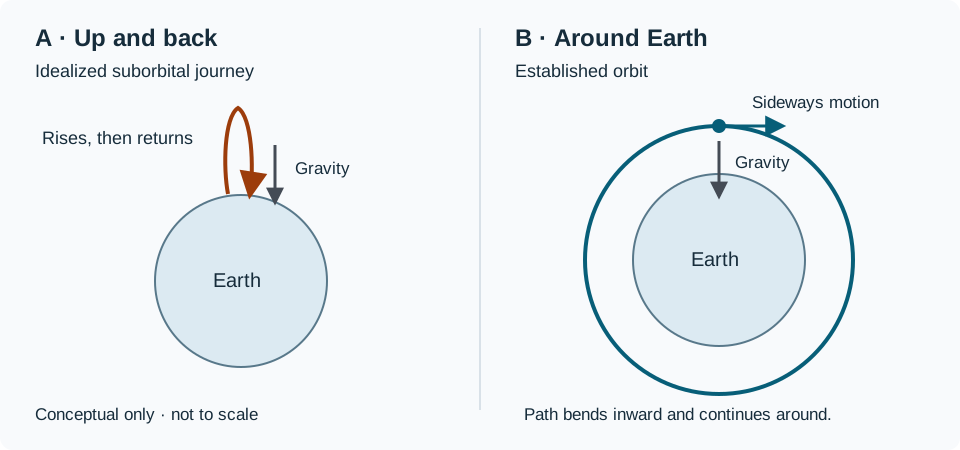
Text equivalent: Path A represents an idealized, predominantly upward, suborbital journey: after the powered climb, the vehicle reaches a high point and returns. Path B represents an established orbit: the spacecraft moves around Earth while gravity continually bends its path inward. Both experience gravity. Only the second drawing shows a path that continues around the planet.
The diagram deliberately leaves out speeds and flight times. Adding one familiar low-Earth-orbit number would invite the wrong lesson that every orbit needs that same number. NASA notes that satellites at different orbital heights travel at different speeds in its comparison of Earth orbits. The useful comparison here is the kind of motion, not a universal target.
Falling can mean going around
To picture an orbit, follow the spacecraft a short distance along its path, then ask where gravity bends that path next. Repeat the question. It can keep moving around the planet while continually falling toward it. “Falling” describes the effect of gravity; it does not require the distance to Earth's surface to shrink at every instant.
ESA uses an imaginary throw from a very tall tower to make the same physical principle visible: with the appropriate sideways speed, the surface curves away beneath the falling object. This is an idealized explanation of orbit, not something to attempt. Read ESA's reaching-orbit explanation.
A useful caption for the orbital panel is therefore “gravity bends the moving spacecraft's path around Earth.” It describes both parts of the picture without treating forward motion as a mysterious force that cancels gravity.
What viewers mean by a gravity turn
You may hear the curved ascent called a gravity turn. In a NASA engineering simulation example, the vehicle's flight path turns under gravity as the rocket accelerates away from the launch site. That illustrates why gravity belongs in an ascent explanation, even while engines are firing. The example is a particular model, not a timetable for all rockets. NASA's flight-simulation check-case report, Volume II.
For a launch viewer, it is enough to distinguish the goal from a specific steering program. The goal is the required orbital motion. A curved line in a broadcast cannot establish every detail of how the vehicle is being guided.
Read the camera view cautiously
A screen shows the flight from one viewpoint. Before deciding that a rocket is “horizontal,” ask what the reference is: the image frame, a visible horizon, or a trajectory graphic. Rotating a camera changes what looks vertical on screen without changing the vehicle's flight.
Try this as a viewing exercise: sketch a curved path on paper, then rotate the paper. The same path now has a different angle relative to your screen or desk. This is a perspective check, not an analysis of any particular launch video. Use the operator's commentary and trajectory information before assigning a technical meaning to the apparent angle.
Also identify which object the shot follows. Our Falcon 9 hardware guide helps distinguish the stages and payload area. A view of one stage should not silently become a claim about another.
The next time a rocket arcs across the sky, keep two questions separate: how high is it, and what path is it building? That distinction also helps when comparing the different orbits used for satellite observations.